 (h/t to mike, who posted this to FB...)
Showing posts with label Mexico. Show all posts
Showing posts with label Mexico. Show all posts
Monday, February 13, 2012

Thursday, March 31, 2011
Battles that Changed History; Columbus, 1916
This month - admittedly, the last DAY of this month, but better late than never, as a Libyan rebel would probably tell you - I begin a change to the "Decisive Battles" series.
I don't want to stop posting about those curiously destructive moments in human ingenuity (or perhaps they should be classed as creative episodes of destruction?); there will still be monthly posts on engagements that were in themselves critical to human conflicts, or in changing human societies, or the relations between and histories of those societies.
But there were also times when humans in arms against each other managed to create a sort of butterfly effect even though the outcome of the day of battle was not in itself decisive. Those battles, although themselves minor or perhaps even trivial in nature, had an impact on human lives well out of proportion to their scope.
When I started the "decisive battles" posts I commented that part of the reason I wanted to talk about the bloody history of human violence was because many of those of my fellow travelers on the Left liked to sport the slogan "Violence Never Solved Anything", as though the Carthaginians or Britons had simply made a wrong turn and disappeared down history's dead-end street, and seemed to believe that if we in the U.S. simply concluded our aggressive warmaking that the rest of the world would smile and pass on by peaceably.
I'm afraid that I didn't and don't believe that. We're a number of things, we homo sapiens, although sapient might not be the most consistent. But one thing we are not is peaceable. No member of the anthropoid family is as irascible, hasty to violence, and slow to reconcile as we are, and throughout our recorded history we never seem to lack the excuse to find some sharp or heavy object with which to do our opposable-thumbed best to kill each other.
So here is the first in the expansion of the "decisive battles" series, a battle that, while as a battle has to fall somewhere between "desultory" and "risible" was the catalyst of one of 20th Century North America's lingering and troublesome issues.
Columbus Date: 9 MAR 1916 Forces Engaged: United States: Seven troops (cavalry equivalent of an infantry company); HHT (Headquarters and Headquarters Troop), F, G, H, K, M, the Machinegun Troop, and a Quartermaster detachment of the 13th U.S. Cavalry Regiment, U.S. Army.
 Casualty returns include soldiers from the regimental band (HHT), Troops F, G, K, L, M, and the MG Troop, so I have tentatively assigned those units to the fight. Assuming that the HHT was probably close to full strength and the others at roughly half (50 out of an authorized 100) it would put the U.S. Army strength at about 400 troopers.
The little town of Columbus was very much a frontier town in 1916. For all that the official end to the Indian Wars had been declared in 1890, the restless activity in Mexico to the south meant that almost everyone in the town - and the 1910 census records a total of 268 souls living in the town, about a tenth of the entire population of Luna County and the second largest town in the county - was, if not armed, capable of figuring out which end of the rifle or pistol the bullet came out.
Assuming that the population of Columbus was similar to that of Luna County as a whole about a little less than half of the people living there were women, and excluding adolescent children and senescent elders the male population of Columbus capable of fighting probably numbered somewhere about 80 to 100 or so.
So; roughly 400 soldiers under COL Slocum, and about 60 to 100 armed civilians, for a total of about 500 American citizens of one form or another. Ejército Conventionalista de México, División del Norte: Despite the name, the "Northern Division" was not anything like the maneuver element of the name today. The "División del Norte" was, at its height, an entire army complete with horse, foot, and artillery troops.
Today we tend to think of Pancho Villa as a "Mexican bandit" and his troops as "Villistas", cartoon banditos complete with the gold tooth, bandoleros, and the floppy sombrero.
But Villa was actually one of the most competent irregular troop commanders of history, and his "Northern Division" was certainly the largest, and probably the most effective, revolutionary army in North America after the Continental Line.
We'll get to the sad tale of the Fall of the División del Norte in a bit, but suffice to say that by the spring of 1916 the once-mighty military power of the State of Chihuahua had come down pretty far in the world.
Estimates of the Villista forces that crossed into the United States in the early morning hours of 9 MAR aren't exact; probably Villa himself wasn't sure exactly how many troops he brought with him that day. But the best modern guess seems to be that about 480 to 500 horsemen took part in the Columbus Raid.
So; approximately 500 rifle-armed mounted infantry/cavalry under GEN José Doroteo Arango Arámbula, better known as Francisco "Pancho" Villa. The Sources: One the U.S. side we have all the usual contemporary written records of a literate, industrial society; military reports, logistical records, newspaper stories. The accuracy isn't always impeccable, but there's lots of material.
Finding an English-language source for the Columbus Raid is also not difficult. Several works have been written about the engagement itself, probably the most seminal being the 1965 monograph "Pancho Villa at Columbus" written by Haldeen Braddy. This work is out of print but can be found summarized in several places, including this interesting document, a 1974 National Park Service form nominating Columbus and Camp Furlong for the "National Register of Historic Places". A 1998 biography of Villa, "The Life and Times of Pancho Villa" by Freidrich Katz contains some worthwhile discussion of the Raid and the circumstances behind it.
Spanish-language sources are difficult to track down without a better knowledge of the language than I possess, but a serious military historian needs to consider both sides of the hill. Among the most probable sources of useful information would seem to be Francisco Alamada's 1964 "Historia de la revolucion en el estado de Chihuahua", and Ulloa's 1968 "La revolucion intervenida: Relaciones diplomaticas entre Mexico y Estados Unidos". Alberto Carranza's "La expedicion punitiva" from 1957 is primarily concerned with the subsequent Pershing Expedition but probably offers some insight into the origins of the American irruption. Mexican newspaper stories of the time, if findable, are often little better than speculation; what news organizations there were in Mexico at the time were typically located in the capital and had few sources along the frontera, and fewer of those were reliable or timely.
It is worth noting that both sides in this conflict had difficulties with the facts. The Mexican sources are often missing altogether, or oral histories taken from the largely-illiterate soldiers of the Northern Division. The United States was not that much better off in 1916; the 1910 census notes that almost one-quarter of the citizens of New Mexico were themselves illiterate. Even among the better-educated Americans sensation and drama tended to interfere with the truth. As you can see below, on the official report of the 9 MAR action - signed by the commander of the 13th Cavalry - the estimated number of attackers overstates the actual number by between 200 and 400 percent. The Campaign: To understand the Columbus Raid, you have to understand a little bit about the history of Mexico in the late 19th and early 20th Century.
First of all, Mexico has been a dictatorship for nearly forty years; from 1877 to 1911 a former Juarista general, Porfirio Diaz, had been the caudillo in Mexico City. His rule brought "stability", for the wealthy, and for the foreign investors looking for a piece of Mexico's mineral and petroleum production. But the average Mexican remained very poor and without much hope of changing that fact. In 1911 a genteel politician named Francisco Madero led a revolution that overthrew Diaz, but he was too conciliatory for Mexican politics; he tried to drag the Diaz supporters ("Porfiristas") back into government but underestimated their vindictiveness, his moderation angered Zapata and the real rebels, and his taxation of foreign oil companies, among other things, irritated the U.S. Madero lasted all of two years.
 In 1913 he was overthrown and murdered by a vicious bastard of an officer whose name - Victoriano Huerta - is still cursed in Mexico as "The Jackal". His regime was officially unrecognized by the U.S., which permitted gunrunning to his enemies which included Emanilio Zapata in the south, and Villa, and Venustiano Carranza, a norteño politician from the state of Coahuila, in the north. Huerta was never secure in his position and the unrest that had started in 1911 never really stopped; soon he was fighting all three of his rivals for control of the country.
Meanwhile, things between Mexico and the U.S., never particularly chummy, began to go pear-shaped again. One of history's truly bizarre moments, the "Tampico Incident" started farcically in April, 1914 with a gringo motor launch on a fuel run, American sailors, Mexican soldiers, and the eventual Mexican refusal to raise the United States flag on its soil and provide it some 21-gun salute love...but the ending was anything but comical - the Yanquis invaded and occupyed the Mexican port of Veracruz for six months.
The confused mess that was the 1913 Revolution eventually tossed Carranza on the throne in July of 1914. Villa had been a pain in Carranza's ass during the anti-Huerta war (Villa had confiscated the property of Spanish expats living in Chihuahua - he'd done the same thing to Chinese but nobody in the Districto Federal cared about some cattle rustled from some damn Chinks - and had either murdered or killed an Englishman named Benton, and his forces had executed this man: a German-American named Gustav Bauch who had been arrested in Juarez, in February 1914. He had also arrested the Governor of Chihuahua, and Carranza had to personally travel to Chihuahua to order Villa to release his guy) and now he refused to accept the man as the President.
Go figure.
The Villista rebellion was a genuine threat to the Carranza regime, which hastened to try and make peace with the Colossus of the North. President Wilson's State Department recognized the Carranza government in October, 1915, taking away some oil leases and mining concessions as a reward. Villa, meanwhile, had shattered his old-school mounted force against Carranza's commander Obregón at the Battle of Celaya in April, where the Carranzista troops were dug in behind wire and supported with machineguns and modern artillery. In other words, a 1915 defense. Villa mounted his boys up, told them (when they complained that the Class V resupply was late) that their courage would be their ammunition, and pointed in the general direction of Celaya.
It was a slaughter. Pancho lost something like 10,000 men, about half killed and half captured. The Northern Division was broken, destroyed; Villa never managed to assemble more than 10,000 men all arms. What was worse for him, his logistics, never his strong point, were failing, and he turned to grabbing up property and loose coin in Chihuahua, some of which belonged to foreigners, including Americans. This, combined with Americans worries about German skulduggery in Mexico, the recent solicitation of the Carranza government for U.S. profits, and the success of Celaya, pushed the U.S.-Carranza pact of October.
That same month the División del Norte moved to attack against what Villa thought was an isolated Carranzista garrison in the town of Agua Prieta in Sonora, across from Douglas, Arizona. According to one of Villa's confidantes the hard-riding general thought the garrison amounted to about 1,200. But U.S. President Wilson had allowed 3,500 Carranzista reinforcements to transit New Mexico and Arizona, bringing the force to over 6,000.
The garrison commander, GEN Plutarco Calles, had learned from Celaya and constructed real WW1-style trenches around the town, complete with mines, wire and interlocking machinegun fields of fire. Villa arrived on 30 OCT 1915 and rested his troops for a day. He believed that a night mounted attack would carry the town; his staff officers thought the entire attack would take less than five hours.
On All Souls Day, preceded only by a brief artillery prep and some demonstrations to hide the direction of his main attack, the main attack went in after midnight on the east and south defenses of Agua Prieta.
Two large searchlights flickered on as the Villista cavalry was charging and the horsemen were butchered by machinegun fire and land mines. The wretched survivors died on the electrified barbed wire. The result was another Celaya; a bloody wreck. Villa wanted another attack on 3 NOV, but by this time his vatos, running out of food and ammo, sick of slaughter, had had enough. The Division del Norte withdrew back to Naco, Sonora, losing more than 1,500 to desertion.
Villa was convinced that the deadly searchlights had been located north of the Border. Although he had sent his troopers across the border to raid for supplies now and then, Villa had generally considered the Americans at least friendly neutrals. Now he was pissed, and wanted as much revenge as he could get. But every week, every day, his military power to take that revenge got weaker. On a raid on Hermosillo, Sonora later in November he tried to get his boys fired up by promising them big fun once they'd taken the town. But that cunning plan backfired; the troopers did break into the town and immediately set to work stealing everything light enough to carry and raping the women to a fare-thee-well. This allowed the Carranzista garrison (and, probably, every Hermosillian with a machete whose wife, sister, mom, or daughter was out in the plaza being fate-worse-than-death-ed) to regroup and give the Villistas a kicking. The raiders were run out of town, losing the supplies they had looted and about fifty lives.
 By March of 1916 Villa and his troops were pretty desperate. They had taken to train robbing; in January some of the boys hit the Compañía del Ferrocarril Nor-Oeste de México in an attempt to bag silver from the mines in Chihuahua. Whatever else they got, they hacked and shot up a bunch of gringos working for a mining company. Villa denied ordering the massacre, but his credit was running damn thin up north of the border.
So on the evening of 8 MAR 1916 as the tired riders pulled up to a halt along the border three miles south of Columbus, it's difficult to say exactly what was in Villa's mind. Part of the mission was undoubtedly logistical. The gringos, soldier and civilian, sleeping in the town to the north had everything what was left of the Northern Division didn't; food, weapons and ammunition (including machineguns at the Army post), money to buy more of the same. They were also just that; gringos, the same damn gringos who had helped trick-fuck them at Agua Prieta. The story has somehow emerged that Villa chose Columbus because of a personal vendetta against one Sam Ravel, who is supposed to have taken Villista money for weapons and never delivered. Why this is believed I am unsure; there doesn't seem to be a contemporary source for the story. Supplies, and revenge - certainly those were enough for Villa to send his scouts north into the falling night.
The Engagement: In "Villa Raids Columbus" Bill Rakocy writes; The little town was, like the rest of the United States, lumbering into the modern age. In the drugstore you could buy not only cigars, candy, and stationery but the new Kodak cameras. The grocery store offered you two dozen Florida oranges for 15 cents and a pound of California rice for a nickel. Model T Fords, military Ford trucks mixed with riding horses, carriages and wagons on the dirt streets.
 "Camp Furlong" was a satellite post of Fort Bliss, Texas. The officers of the 13th Cavalry were quartered north of the depot, in the center of town, and the troop barracks were to the south, with the horse lines in stables just east of the barracks. Regimental HQ was located between the depot and the barrack block.
 The evening of Wednesday, 8 MAR 1916 was the end of just another normal day. The druggist, the grocer, and the undertaker locked up, went home for dinner. People fed their chickens, pigs, and horses. COL Slocum and several other officers had driven up to Deming for a polo match the next day. The duty officer posted his night guards. The chill of the early Spring evening settled in over Columbus.
Villa is supposed to have remained on the Mexican side of the border early in the evening, dispatching an unknown but probably small number of recon troopers to scout the town and the military camp. It is difficult at this remove to say anything more than whoever these oxygen-thieves were and whatever else they did, they helped hose their commander as thoroughly as any soldiers in history. Reportedly they informed Villa that less than a company of U.S. troops was posted in Columbus, one tenth of the actual number of U.S. soldiers stationed there. As scouts, these Villistas were about as failed as a trooper could be.
The actual plan of attack is unclear. Braddy says that the Mexican force crossed the border fence at about one o’clock in the morning about two and a half miles west of the main crossing between Columbus and the Mexican border town of Palomas and rode slowly and quietly to a position about a mile south of town. At this, what in the modern U.S. Army we would call an "objective rally point" or ORP, Villa gave his operations order. We can't be sure how the force was divided. Braddy says that some of the troops dismounted as infantry, while others remained in the saddle. He also says that the force "divided into two columns", which does sound like the sort of envelop-and-destroy tactic that an irregular horseman would prefer. But he also states that "Villa would wait with reserves near Cootes Hill", which sounds unlikely, given Villa's lack of reserves at both Celaya and Agua Prieta. It may be that Villa chose Cootes Hill as a combined command and observation post but it is unlikely that he kept any but his bodyguards nearby. What is very likely, however, is that some time after 4am in the pre-dawn darkness he said something like “Vaya los consiguen, muchachos!” and his troopers went out to meet the Americans.
All the sources seem to agree that the first shots were fired by Private Fred Griffin of K Troop who was at his guard post at the Regimental HQ. He is said to have issued a challenge - probably something similar to the "Halt! Who's there?" that U.S. Army soldiers are still taught to challenge approaching strangers - and was hit by fire in the gut, chest, and arm. He is reported to have killed three of his attackers before dying of his wounds.
The night raiders did what raiders are supposed to do - sew confusion. They fired as anything moving, shouted, and almost immediately started fires, including at the large Commercial Hotel. The initial resistance was chaotic, as some people immediately fought back, others tried to get to safety, while others, probably, were too dazed to do either. As always, the civilians got it the worst.
Pregnant Mary James was killed trying to run to the fire-resistant Hoover Hotel. Her husband Milton made it, but Mary and the baby died in the street.
Mrs. Parks the switchboard operator got a call out that the town was attacked, cut up on her hands and face by bullet-shattered window glass. The Frosts had a Model T and tried to escape north to Deming with their little three-month-old; he was wounded, and she pushed him out from behind the wheel and sped out of town to safety. Mrs. Lieutenant Smyser and her two kids tumbled out a window as the Mexican troops hammered on the front door. They hid in an outhouse and then ran out into the open desert to hide until morning. Mrs. Riggs was frantic to keep her baby quiet. She held a pillowcase over his face as the Villistas searched the porch and yard; the little boy was nearly suffocated before the raiders moved on and she could let him cry again. Three men and a woman were dragged out of their rooms in the Commercial Hotel. The men were robbed of what they had and then shot to death The woman shouted “Viva Mexico!” and was turned loose. Newly married John Walton Walker was killed on the hotel stairs while Steve Birchfield wrote out personal checks to his each of the Mexican soldiers who captured him and bought his survival.
Arthur Ravel, son of the supposed Villa target Sam, was captured and dragged off to the Commercial but escaped when two of the Mexican troops were shot down. The fourteen-year-old ran three miles in his underwear into the desert.
The 13th Cavalry started from complete surprise and disorganization. The Staff Duty Officer, Lieutenant James P. Castleman was in his quarters when the attack started and was nearly killed running to the formation area near the barracks. Once there, he took command of his Troop F, which had been formed and issued rifles by his First Sergeant. The weapons had been locked in the regimental arms room in the guardhouse, and the quartermaster sergeant had not been located, so the first troopers to reach the guardhouse hammered the locks off the rifle racks. More cavalrymen fought back, probably not so much as formed troops but in groups of two, five, and squads or half-platoons. The consolidating U.S. forces soon pushed the Villista force attacking from the southeast back and secured the Regimental Headquarters. LT Castleman's troops pushed northwest into the center of town, clearing raiders out from the homes and stores until they controlled the central streets
Meanwhile the MG Troop, under LT John Lucas - who had reported for duty barefoot because he had dropped his boots somewhere under the bed and couldn't find them - pushed their guns out to the west. The U.S. Army's standard machinegun in 1916 was a finicky atrocity called the Benet-Mercier that fired a fixed strip of 30 rounds and was referred to as the "daylight gun" because of its frequent jams, misfires, and broken firing pins and extractors. The MG troop pushed into the center of town where the Villistas found that their arson now worked against them. The burning buildings made perfect backlighting for the U.S. troopers, who set up interlocking fires and cut down the randomly-attacking Mexican soldiers. As whenever a fixed facility is attacked, even the support troops found themselves fighting. Braddy reports that "The post kitchen detail, already preparing the morning breakfast, counterattacked with boiling water, an ax and shotguns. The stable detail counterattacked with whatever weapons came to hand, with one trooper using a baseball bat to kill a raider." At about 5:30am COL Slocum and his polo party turned up and took command. At this point the "raid" had stalled, the Americans were forming up and counterattacking more aggressively, and it was clear to Villa that many more cavalrymen were in and around Columbus than he had been told. It was time to go.
 The Mexican signallers used bugle calls to order a retreat. The Mexican withdrawl was not systematic, and 13th Cavalry pursuit chased them back five miles across the border, continuing to kill Mexican soldiers until the men exhausted their ammunition, food and water.
The casualties for the two sides were painfully lopsided. The official 13th Cavalry report lists seven men killed; two sergeants, two corporals, a farrier, and two privates. Seven soldiers are reported wounded, three seriously including a corporal hit in the neck, and two privates shot through both thighs, one with a head wound as well. It is very possible that one of these men died later, resulting in the 8 U.S. soldiers usually reported killed in action. About 10 American civilians were killed, 2 wounded, which argues that most of the dead were shot while held at close range - murdered while prisoners or shot down at close enough range to be distinct as women or unarmed men. The dawn on 9 MAR must have been a painful one for everyone left alive in Columbus.
 But the División del Norte payed a much higher price. Something between 65 and 75 Mexican troopers were dead in and around Columbus and in the desert beyond. As many as 100 or more had ridden away with wounds of some sort. Five were captured; all were hanged the following day.
The troopers of the 13th Cavalry were somewhat surprised to find that instead of hard-bitten throat-slitters the bodies they inspected and the prisoners they took were largely farm boys; 14- and 15-year-olds taken off the haciendas in northern Mexico to fight for a cause they may not even have understood and die in the cold desert of a strange country.
The Outcome: Minor tactical U.S. victory, but with significant geopolitical consequences.
The Impact: Well, the immediate impact was an outburst of rage inside the United States. On 15 MAR GEN John "Black Jack" Pershing led six cavalry (including the 13th) and four infantry regiments over the border into Mexico with the President's order to capture or kill Villa and the raiders of Columbus. After a period of initial chagrin the Carranza government warned that the U.S. troops would be considered invaders, and in June a skirmish between two troops of the 10th U.S. Cavalry - attacking the town of Carrizal on the report that Villa was wounded and helpless there - and a Mexican infantry company garrisoning the town resulted in the loss of 39 of the 100 cavalrymen (16 killed, 23 POW) and the effective destruction of the units. The action was an Agua Prieta in cameo, but this engagement found the Yanqui cavalry charging dug-in Mexican infantry and paying the price for their boldness. The Mexican troops lost nearly a third of their own numbers dead or wounded.
 The only benefit from this pointless butchery was the way it brought both sides to their senses. While Wilson had originally requested - and received - permission from Carranza's government to enter Mexico and track down Villa, the expected fighting soon broke out between two countries with little love for each other and two armies with very different attitudes.
 The Mexican Army had a long memory for the humiliations they had been handed by the gringos, from Chapultepec to Veracruz. The Americans had nothing but contempt for their hosts, seeing not soldiers but just more beaners in uniforms.
 What made matters worse is that in May the commander of the Mexican forces in Chihuahua had ordered Pershing not to move from his present positions unless it was to return back across the border. Pershing had replied that he would move where and when he fucking well pleased, and now the U.S. and Mexican troops had fought to the death. The U.S. government had been worried enough to mobilize the entire border states' National Guard, and with more than 100,000 troops position on the frontier the chances for general war looked frighteningly high.
 This neither Carranza nor Wilson wanted. The Mexican Army hastily released the captured cavalrymen (whom, it was noted in the Mexican press, were all negro "buffalo soldiers", which has led to the tale common in Mexico even today that the Yanquis sent only their despised soldados mallates into Mexico whilst the whites lounged about back at the border.
On order of the War Department Pershing and his troops spent the next seven months bivouacked in Colonia Dublan, about 85 miles south of Columbus. In early February, 1917, the Expeditionary Force recrossed the border and the Punitive Expedition was over. It had killed 135 Mexicans of various flavors, mostly but not entirely Villa's troops, wounded 85, and captured 19. Villa himself, however, had more lives than a cat. He reemerged from the hills of Chihuahua in July, 1916, and (prudently avoiding the Americans) began attacking Carranzista garrisons. In November he took Chihuahua City and offered the 2,000 soldiers there two choices; death, or glory with the División del Norte. Unsurprisingly they chose the latter. Villa, who when Pershing's force had entered the State of Chihuahua in March 1916 had numbered something less than 400 badly demoralized troopers, saw January, 1917 as the commander of an army of 5,000.
Both sides claimed victory.
Villa continued his rebellion until mid-1919, when yet another botched headlong attack, this time on Ciudad Juarez, and another U.S. punitive force, this one led by BG Erwin, the post commander of nearby Ft. Bliss, smashed his remaining forces and knocked the old caudillo out of the war business. He "retired" in 1920 and was gunned down, probably by gunsels hired by his old enemy Obregón (who was by that time the President of Mexico) in July, 1923. Hit by nine rounds, Villa died instantly at the wheel of his Dodge. He passed into history as the ultimate Mexican bandit and inspiration for dozens of feckless and stupid young Mexicans.
 Columbus experienced a brief boom as a service town during the Punitive Expedition.
 U.S. domestic military supply lines terminated there, and the 1st Aero Squadron - the entire eight biplanes that were the USAF of 1916 - was stationed at Camp Furlong.
The 20,000 troops made Columbus was the largest urban area in New Mexico for almost two years. But after 1917 the effect of isolation, poverty, and in particular the Depression, reduced the town to several hundred. For a period in the Fifties Columbus was described in guidebooks as "abandoned" after the rail service ended and the town deteriorated badly.
 You can see from these pictures, taken in the 1970s as support for declaring the town and the remains of Camp Furlong a "National Historic Place", just how badly the little town had fallen apart.
 The town has recovered...somewhat...today.
 The population, over 1,700 on the 2000 census, is now largely Hispanic (83% of the people living in Columbus is listed as "Hispanic or Latino of any race"), young (almost 2 out of five below the age of 18), and poor. The per capita income for the village was $6,721, and about 57% of families were living below the U.S. federal poverty line.
What I find particularly interesting is that, long after being chased across the border well whipped, the old caudillo of Chihuahua seems to have won in the end.
The now-mostly-Mexican-American town of Columbus celebrates something called the Cabalgata Binacional Villista every 9th of March. This involves about 100 Mexican riders led by a Pancho look-a-like who follow Villa's invasion route across the border and parade into Columbus. The Mexicans are met at the border by a group of American riders and they trot to the Columbus plaza for a festival that includes trick riding and Mariachi music.
Thousands of people are said to come from around the region. "This was our big historical moment. What better opportunity for a party?" asks one of the organizers, Linda Juarez.
Some of the older Columbus residents aren't as excited about all this Villaosity.
One man who says his great-grandfather was killed on 9 MAR, compares the party to feasting with bin Laden on September 11;
But the loud mariachis of the Cabalgata continue to drown out the attempts of the former town worthies, men like Dean, to turn thoughts to the Anglo dead and retake what was once fiercely theirs. These sons and grandsons of old Columbus find their ancestors' tombs untended and, behind their fortresslike wall, fear and hate a new generation of raiders.
It seems time, poverty, and lack of care will succeed where the guns of the División del Norte failed. Touchline Tattles: While the story of the original raid is just another page in the dreary, bloody story of the Mexican-American border and the Revolution of 1910, the story that has emerged from the little desert town 95 years later is almost good enough to be fiction.
Is seems that early this March the mayor of Columbus, its police chief, and a town councilman were among 11 Columbus residents indicted for purchasing and selling as many as 200 automatic and semiauto weapons. These included AKM machinepistols and (I'm guessing) 9mm Beretta service pistols, modern military arms for the wannabe Villista...because these munitions were being sold to the Mexican narcotraficantes; the soldiers of the drug cartels.
So after almost 100 years the guns go south again, to those who see themselves as modern rebels and latter-day Pancho Villas, whose bullets once again shake loose La Frontera, the unquiet border between the worlds. And behind the dusty veil of years, the ghosts of the tired troopers still sing as they march;
"We left the border for Parral
In search of Villa and Lopez, his old pal.
Our horses, they were hungry,
And we ate parched corn.
It was damn hard living
In the state of Chihuahua
Where Pancho Villa was born."
I don't want to stop posting about those curiously destructive moments in human ingenuity (or perhaps they should be classed as creative episodes of destruction?); there will still be monthly posts on engagements that were in themselves critical to human conflicts, or in changing human societies, or the relations between and histories of those societies.
But there were also times when humans in arms against each other managed to create a sort of butterfly effect even though the outcome of the day of battle was not in itself decisive. Those battles, although themselves minor or perhaps even trivial in nature, had an impact on human lives well out of proportion to their scope.
When I started the "decisive battles" posts I commented that part of the reason I wanted to talk about the bloody history of human violence was because many of those of my fellow travelers on the Left liked to sport the slogan "Violence Never Solved Anything", as though the Carthaginians or Britons had simply made a wrong turn and disappeared down history's dead-end street, and seemed to believe that if we in the U.S. simply concluded our aggressive warmaking that the rest of the world would smile and pass on by peaceably.
I'm afraid that I didn't and don't believe that. We're a number of things, we homo sapiens, although sapient might not be the most consistent. But one thing we are not is peaceable. No member of the anthropoid family is as irascible, hasty to violence, and slow to reconcile as we are, and throughout our recorded history we never seem to lack the excuse to find some sharp or heavy object with which to do our opposable-thumbed best to kill each other.
So here is the first in the expansion of the "decisive battles" series, a battle that, while as a battle has to fall somewhere between "desultory" and "risible" was the catalyst of one of 20th Century North America's lingering and troublesome issues.
Columbus Date: 9 MAR 1916
 Forces Engaged: United States: Seven troops (cavalry equivalent of an infantry company); HHT (Headquarters and Headquarters Troop), F, G, H, K, M, the Machinegun Troop, and a Quartermaster detachment of the 13th U.S. Cavalry Regiment, U.S. Army.
NOTE: A U.S. cavalry regiment of 1916 (led by a full colonel [what the modern U.S. army calls pay grade O-6]) was notionally organized into three battalions (each led by a lieutenant colonel [grade O-5]). Each battalion contained four troops, each led by a captain, [Grade O-3]. The authorized strength of a full regiment was roughly 1,500 troopers, a troop about 100, but prior to WW1 the U.S. Army was almost never fully manned. Most of the 13th Cavalry troops at Columbus probably averaged about 40 to 60 soldiers, the Headquarters troop probably somewhat larger since it included the regimental commander and his entire staff.There seems to be some confusion over exactly how many elements of the 13th Cavalry were engaged at Columbus. Most of the sources claim that about 300 U.S. soldiers fought that night; this would roughly fit the number of cavalry troops posted at Camp Furlong, the Army post close to Columbus. However, several sources state that "three troops" were engaged, including the Wiki entry, which puts the number of U.S. soldiers engaged at 330.
 Casualty returns include soldiers from the regimental band (HHT), Troops F, G, K, L, M, and the MG Troop, so I have tentatively assigned those units to the fight. Assuming that the HHT was probably close to full strength and the others at roughly half (50 out of an authorized 100) it would put the U.S. Army strength at about 400 troopers.
The little town of Columbus was very much a frontier town in 1916. For all that the official end to the Indian Wars had been declared in 1890, the restless activity in Mexico to the south meant that almost everyone in the town - and the 1910 census records a total of 268 souls living in the town, about a tenth of the entire population of Luna County and the second largest town in the county - was, if not armed, capable of figuring out which end of the rifle or pistol the bullet came out.
Assuming that the population of Columbus was similar to that of Luna County as a whole about a little less than half of the people living there were women, and excluding adolescent children and senescent elders the male population of Columbus capable of fighting probably numbered somewhere about 80 to 100 or so.
So; roughly 400 soldiers under COL Slocum, and about 60 to 100 armed civilians, for a total of about 500 American citizens of one form or another.
 Ejército Conventionalista de México, División del Norte: Despite the name, the "Northern Division" was not anything like the maneuver element of the name today. The "División del Norte" was, at its height, an entire army complete with horse, foot, and artillery troops.
Today we tend to think of Pancho Villa as a "Mexican bandit" and his troops as "Villistas", cartoon banditos complete with the gold tooth, bandoleros, and the floppy sombrero.

But Villa was actually one of the most competent irregular troop commanders of history, and his "Northern Division" was certainly the largest, and probably the most effective, revolutionary army in North America after the Continental Line.
We'll get to the sad tale of the Fall of the División del Norte in a bit, but suffice to say that by the spring of 1916 the once-mighty military power of the State of Chihuahua had come down pretty far in the world.
Estimates of the Villista forces that crossed into the United States in the early morning hours of 9 MAR aren't exact; probably Villa himself wasn't sure exactly how many troops he brought with him that day. But the best modern guess seems to be that about 480 to 500 horsemen took part in the Columbus Raid.
So; approximately 500 rifle-armed mounted infantry/cavalry under GEN José Doroteo Arango Arámbula, better known as Francisco "Pancho" Villa.
 The Sources: One the U.S. side we have all the usual contemporary written records of a literate, industrial society; military reports, logistical records, newspaper stories. The accuracy isn't always impeccable, but there's lots of material.
Finding an English-language source for the Columbus Raid is also not difficult. Several works have been written about the engagement itself, probably the most seminal being the 1965 monograph "Pancho Villa at Columbus" written by Haldeen Braddy. This work is out of print but can be found summarized in several places, including this interesting document, a 1974 National Park Service form nominating Columbus and Camp Furlong for the "National Register of Historic Places".
 A 1998 biography of Villa, "The Life and Times of Pancho Villa" by Freidrich Katz contains some worthwhile discussion of the Raid and the circumstances behind it.
Spanish-language sources are difficult to track down without a better knowledge of the language than I possess, but a serious military historian needs to consider both sides of the hill. Among the most probable sources of useful information would seem to be Francisco Alamada's 1964 "Historia de la revolucion en el estado de Chihuahua", and Ulloa's 1968 "La revolucion intervenida: Relaciones diplomaticas entre Mexico y Estados Unidos". Alberto Carranza's "La expedicion punitiva" from 1957 is primarily concerned with the subsequent Pershing Expedition but probably offers some insight into the origins of the American irruption. Mexican newspaper stories of the time, if findable, are often little better than speculation; what news organizations there were in Mexico at the time were typically located in the capital and had few sources along the frontera, and fewer of those were reliable or timely.
It is worth noting that both sides in this conflict had difficulties with the facts. The Mexican sources are often missing altogether, or oral histories taken from the largely-illiterate soldiers of the Northern Division. The United States was not that much better off in 1916; the 1910 census notes that almost one-quarter of the citizens of New Mexico were themselves illiterate. Even among the better-educated Americans sensation and drama tended to interfere with the truth. As you can see below, on the official report of the 9 MAR action - signed by the commander of the 13th Cavalry - the estimated number of attackers overstates the actual number by between 200 and 400 percent.
 The Campaign: To understand the Columbus Raid, you have to understand a little bit about the history of Mexico in the late 19th and early 20th Century.
First of all, Mexico has been a dictatorship for nearly forty years; from 1877 to 1911 a former Juarista general, Porfirio Diaz, had been the caudillo in Mexico City. His rule brought "stability", for the wealthy, and for the foreign investors looking for a piece of Mexico's mineral and petroleum production. But the average Mexican remained very poor and without much hope of changing that fact.
 In 1911 a genteel politician named Francisco Madero led a revolution that overthrew Diaz, but he was too conciliatory for Mexican politics; he tried to drag the Diaz supporters ("Porfiristas") back into government but underestimated their vindictiveness, his moderation angered Zapata and the real rebels, and his taxation of foreign oil companies, among other things, irritated the U.S. Madero lasted all of two years.
 In 1913 he was overthrown and murdered by a vicious bastard of an officer whose name - Victoriano Huerta - is still cursed in Mexico as "The Jackal". His regime was officially unrecognized by the U.S., which permitted gunrunning to his enemies which included Emanilio Zapata in the south, and Villa, and Venustiano Carranza, a norteño politician from the state of Coahuila, in the north. Huerta was never secure in his position and the unrest that had started in 1911 never really stopped; soon he was fighting all three of his rivals for control of the country.
Meanwhile, things between Mexico and the U.S., never particularly chummy, began to go pear-shaped again. One of history's truly bizarre moments, the "Tampico Incident" started farcically in April, 1914 with a gringo motor launch on a fuel run, American sailors, Mexican soldiers, and the eventual Mexican refusal to raise the United States flag on its soil and provide it some 21-gun salute love...but the ending was anything but comical - the Yanquis invaded and occupyed the Mexican port of Veracruz for six months.
The confused mess that was the 1913 Revolution eventually tossed Carranza on the throne in July of 1914. Villa had been a pain in Carranza's ass during the anti-Huerta war (Villa had confiscated the property of Spanish expats living in Chihuahua - he'd done the same thing to Chinese but nobody in the Districto Federal cared about some cattle rustled from some damn Chinks - and had either murdered or killed an Englishman named Benton, and his forces had executed this man:
 a German-American named Gustav Bauch who had been arrested in Juarez, in February 1914. He had also arrested the Governor of Chihuahua, and Carranza had to personally travel to Chihuahua to order Villa to release his guy) and now he refused to accept the man as the President.
Go figure.
The Villista rebellion was a genuine threat to the Carranza regime, which hastened to try and make peace with the Colossus of the North. President Wilson's State Department recognized the Carranza government in October, 1915, taking away some oil leases and mining concessions as a reward. Villa, meanwhile, had shattered his old-school mounted force against Carranza's commander Obregón at the Battle of Celaya in April, where the Carranzista troops were dug in behind wire and supported with machineguns and modern artillery. In other words, a 1915 defense. Villa mounted his boys up, told them (when they complained that the Class V resupply was late) that their courage would be their ammunition, and pointed in the general direction of Celaya.
It was a slaughter.
 Pancho lost something like 10,000 men, about half killed and half captured. The Northern Division was broken, destroyed; Villa never managed to assemble more than 10,000 men all arms. What was worse for him, his logistics, never his strong point, were failing, and he turned to grabbing up property and loose coin in Chihuahua, some of which belonged to foreigners, including Americans. This, combined with Americans worries about German skulduggery in Mexico, the recent solicitation of the Carranza government for U.S. profits, and the success of Celaya, pushed the U.S.-Carranza pact of October.
That same month the División del Norte moved to attack against what Villa thought was an isolated Carranzista garrison in the town of Agua Prieta in Sonora, across from Douglas, Arizona. According to one of Villa's confidantes the hard-riding general thought the garrison amounted to about 1,200. But U.S. President Wilson had allowed 3,500 Carranzista reinforcements to transit New Mexico and Arizona, bringing the force to over 6,000.
The garrison commander, GEN Plutarco Calles, had learned from Celaya and constructed real WW1-style trenches around the town, complete with mines, wire and interlocking machinegun fields of fire.
 Villa arrived on 30 OCT 1915 and rested his troops for a day. He believed that a night mounted attack would carry the town; his staff officers thought the entire attack would take less than five hours.
On All Souls Day, preceded only by a brief artillery prep and some demonstrations to hide the direction of his main attack, the main attack went in after midnight on the east and south defenses of Agua Prieta.
Two large searchlights flickered on as the Villista cavalry was charging and the horsemen were butchered by machinegun fire and land mines. The wretched survivors died on the electrified barbed wire. The result was another Celaya; a bloody wreck.
 Villa wanted another attack on 3 NOV, but by this time his vatos, running out of food and ammo, sick of slaughter, had had enough. The Division del Norte withdrew back to Naco, Sonora, losing more than 1,500 to desertion.
Villa was convinced that the deadly searchlights had been located north of the Border. Although he had sent his troopers across the border to raid for supplies now and then, Villa had generally considered the Americans at least friendly neutrals. Now he was pissed, and wanted as much revenge as he could get.
 But every week, every day, his military power to take that revenge got weaker. On a raid on Hermosillo, Sonora later in November he tried to get his boys fired up by promising them big fun once they'd taken the town. But that cunning plan backfired; the troopers did break into the town and immediately set to work stealing everything light enough to carry and raping the women to a fare-thee-well. This allowed the Carranzista garrison (and, probably, every Hermosillian with a machete whose wife, sister, mom, or daughter was out in the plaza being fate-worse-than-death-ed) to regroup and give the Villistas a kicking. The raiders were run out of town, losing the supplies they had looted and about fifty lives.
 By March of 1916 Villa and his troops were pretty desperate. They had taken to train robbing; in January some of the boys hit the Compañía del Ferrocarril Nor-Oeste de México in an attempt to bag silver from the mines in Chihuahua. Whatever else they got, they hacked and shot up a bunch of gringos working for a mining company. Villa denied ordering the massacre, but his credit was running damn thin up north of the border.
So on the evening of 8 MAR 1916 as the tired riders pulled up to a halt along the border three miles south of Columbus, it's difficult to say exactly what was in Villa's mind.
 Part of the mission was undoubtedly logistical. The gringos, soldier and civilian, sleeping in the town to the north had everything what was left of the Northern Division didn't; food, weapons and ammunition (including machineguns at the Army post), money to buy more of the same. They were also just that; gringos, the same damn gringos who had helped trick-fuck them at Agua Prieta. The story has somehow emerged that Villa chose Columbus because of a personal vendetta against one Sam Ravel, who is supposed to have taken Villista money for weapons and never delivered. Why this is believed I am unsure; there doesn't seem to be a contemporary source for the story. Supplies, and revenge - certainly those were enough for Villa to send his scouts north into the falling night.
The Engagement: In "Villa Raids Columbus" Bill Rakocy writes;
"Jack Thomas, deputy sheriff, and other officials sensed something in the air. They had noticed strange Mexicans in town. Many "friendly Mexicans" became silent and some left town. Juan Favela, a local ranch foreman, complained that “the air was bad.”The town of Columbus is located in a shallow basin in part of the high plateau known as the Chihuahuan Desert. The place had only sprung up in the last decade or so, a watering stop for the El Paso & Southwest Railroad and a border crossing point. Deming, 35 miles north, was the Big Town.
“The straggling town consisted of a cluster of adobe houses, some frame buildings, a railroad station, two hotels, a few other business establishments, and an army camp.” (Braddy)The "commercial district" was to the north of the railroad station, which included a drug, grocery, and a hardware store, a bank, the post office, a movie theater, what we would call today a "funeral home" and was then the undertaker, and two hotels, the adobe Hoover and the wood-frame Commercial Hotel. A small eminence named Cootes Hill rose from the desert about a half-mile or so to the west of town.
 The little town was, like the rest of the United States, lumbering into the modern age. In the drugstore you could buy not only cigars, candy, and stationery but the new Kodak cameras. The grocery store offered you two dozen Florida oranges for 15 cents and a pound of California rice for a nickel. Model T Fords, military Ford trucks mixed with riding horses, carriages and wagons on the dirt streets.
 "Camp Furlong" was a satellite post of Fort Bliss, Texas. The officers of the 13th Cavalry were quartered north of the depot, in the center of town, and the troop barracks were to the south, with the horse lines in stables just east of the barracks. Regimental HQ was located between the depot and the barrack block.
 The evening of Wednesday, 8 MAR 1916 was the end of just another normal day. The druggist, the grocer, and the undertaker locked up, went home for dinner. People fed their chickens, pigs, and horses. COL Slocum and several other officers had driven up to Deming for a polo match the next day. The duty officer posted his night guards. The chill of the early Spring evening settled in over Columbus.
Villa is supposed to have remained on the Mexican side of the border early in the evening, dispatching an unknown but probably small number of recon troopers to scout the town and the military camp. It is difficult at this remove to say anything more than whoever these oxygen-thieves were and whatever else they did, they helped hose their commander as thoroughly as any soldiers in history. Reportedly they informed Villa that less than a company of U.S. troops was posted in Columbus, one tenth of the actual number of U.S. soldiers stationed there. As scouts, these Villistas were about as failed as a trooper could be.
The actual plan of attack is unclear. Braddy says that the Mexican force crossed the border fence at about one o’clock in the morning about two and a half miles west of the main crossing between Columbus and the Mexican border town of Palomas and rode slowly and quietly to a position about a mile south of town.
 At this, what in the modern U.S. Army we would call an "objective rally point" or ORP, Villa gave his operations order. We can't be sure how the force was divided. Braddy says that some of the troops dismounted as infantry, while others remained in the saddle. He also says that the force "divided into two columns", which does sound like the sort of envelop-and-destroy tactic that an irregular horseman would prefer. But he also states that "Villa would wait with reserves near Cootes Hill", which sounds unlikely, given Villa's lack of reserves at both Celaya and Agua Prieta. It may be that Villa chose Cootes Hill as a combined command and observation post but it is unlikely that he kept any but his bodyguards nearby. What is very likely, however, is that some time after 4am in the pre-dawn darkness he said something like “Vaya los consiguen, muchachos!” and his troopers went out to meet the Americans.
All the sources seem to agree that the first shots were fired by Private Fred Griffin of K Troop who was at his guard post at the Regimental HQ. He is said to have issued a challenge - probably something similar to the "Halt! Who's there?" that U.S. Army soldiers are still taught to challenge approaching strangers - and was hit by fire in the gut, chest, and arm. He is reported to have killed three of his attackers before dying of his wounds.
The night raiders did what raiders are supposed to do - sew confusion. They fired as anything moving, shouted, and almost immediately started fires, including at the large Commercial Hotel. The initial resistance was chaotic, as some people immediately fought back, others tried to get to safety, while others, probably, were too dazed to do either.
 As always, the civilians got it the worst.
Pregnant Mary James was killed trying to run to the fire-resistant Hoover Hotel. Her husband Milton made it, but Mary and the baby died in the street.
Mrs. Parks the switchboard operator got a call out that the town was attacked, cut up on her hands and face by bullet-shattered window glass. The Frosts had a Model T and tried to escape north to Deming with their little three-month-old; he was wounded, and she pushed him out from behind the wheel and sped out of town to safety. Mrs. Lieutenant Smyser and her two kids tumbled out a window as the Mexican troops hammered on the front door. They hid in an outhouse and then ran out into the open desert to hide until morning. Mrs. Riggs was frantic to keep her baby quiet. She held a pillowcase over his face as the Villistas searched the porch and yard; the little boy was nearly suffocated before the raiders moved on and she could let him cry again.
 Three men and a woman were dragged out of their rooms in the Commercial Hotel. The men were robbed of what they had and then shot to death The woman shouted “Viva Mexico!” and was turned loose. Newly married John Walton Walker was killed on the hotel stairs while Steve Birchfield wrote out personal checks to his each of the Mexican soldiers who captured him and bought his survival.
 Arthur Ravel, son of the supposed Villa target Sam, was captured and dragged off to the Commercial but escaped when two of the Mexican troops were shot down. The fourteen-year-old ran three miles in his underwear into the desert.
The 13th Cavalry started from complete surprise and disorganization. The Staff Duty Officer, Lieutenant James P. Castleman was in his quarters when the attack started and was nearly killed running to the formation area near the barracks. Once there, he took command of his Troop F, which had been formed and issued rifles by his First Sergeant. The weapons had been locked in the regimental arms room in the guardhouse, and the quartermaster sergeant had not been located, so the first troopers to reach the guardhouse hammered the locks off the rifle racks.
 More cavalrymen fought back, probably not so much as formed troops but in groups of two, five, and squads or half-platoons. The consolidating U.S. forces soon pushed the Villista force attacking from the southeast back and secured the Regimental Headquarters. LT Castleman's troops pushed northwest into the center of town, clearing raiders out from the homes and stores until they controlled the central streets
Meanwhile the MG Troop, under LT John Lucas - who had reported for duty barefoot because he had dropped his boots somewhere under the bed and couldn't find them - pushed their guns out to the west. The U.S. Army's standard machinegun in 1916 was a finicky atrocity called the Benet-Mercier that fired a fixed strip of 30 rounds and was referred to as the "daylight gun" because of its frequent jams, misfires, and broken firing pins and extractors.
 The MG troop pushed into the center of town where the Villistas found that their arson now worked against them. The burning buildings made perfect backlighting for the U.S. troopers, who set up interlocking fires and cut down the randomly-attacking Mexican soldiers. As whenever a fixed facility is attacked, even the support troops found themselves fighting. Braddy reports that "The post kitchen detail, already preparing the morning breakfast, counterattacked with boiling water, an ax and shotguns. The stable detail counterattacked with whatever weapons came to hand, with one trooper using a baseball bat to kill a raider." At about 5:30am COL Slocum and his polo party turned up and took command. At this point the "raid" had stalled, the Americans were forming up and counterattacking more aggressively, and it was clear to Villa that many more cavalrymen were in and around Columbus than he had been told. It was time to go.
 The Mexican signallers used bugle calls to order a retreat. The Mexican withdrawl was not systematic, and 13th Cavalry pursuit chased them back five miles across the border, continuing to kill Mexican soldiers until the men exhausted their ammunition, food and water.
The casualties for the two sides were painfully lopsided. The official 13th Cavalry report lists seven men killed; two sergeants, two corporals, a farrier, and two privates. Seven soldiers are reported wounded, three seriously including a corporal hit in the neck, and two privates shot through both thighs, one with a head wound as well. It is very possible that one of these men died later, resulting in the 8 U.S. soldiers usually reported killed in action. About 10 American civilians were killed, 2 wounded, which argues that most of the dead were shot while held at close range - murdered while prisoners or shot down at close enough range to be distinct as women or unarmed men.
 The dawn on 9 MAR must have been a painful one for everyone left alive in Columbus.
 But the División del Norte payed a much higher price. Something between 65 and 75 Mexican troopers were dead in and around Columbus and in the desert beyond. As many as 100 or more had ridden away with wounds of some sort. Five were captured; all were hanged the following day.
The troopers of the 13th Cavalry were somewhat surprised to find that instead of hard-bitten throat-slitters the bodies they inspected and the prisoners they took were largely farm boys; 14- and 15-year-olds taken off the haciendas in northern Mexico to fight for a cause they may not even have understood and die in the cold desert of a strange country.
The Outcome: Minor tactical U.S. victory, but with significant geopolitical consequences.
The Impact: Well, the immediate impact was an outburst of rage inside the United States. On 15 MAR GEN John "Black Jack" Pershing led six cavalry (including the 13th) and four infantry regiments over the border into Mexico with the President's order to capture or kill Villa and the raiders of Columbus.
 After a period of initial chagrin the Carranza government warned that the U.S. troops would be considered invaders, and in June a skirmish between two troops of the 10th U.S. Cavalry - attacking the town of Carrizal on the report that Villa was wounded and helpless there - and a Mexican infantry company garrisoning the town resulted in the loss of 39 of the 100 cavalrymen (16 killed, 23 POW) and the effective destruction of the units. The action was an Agua Prieta in cameo, but this engagement found the Yanqui cavalry charging dug-in Mexican infantry and paying the price for their boldness. The Mexican troops lost nearly a third of their own numbers dead or wounded.
 The only benefit from this pointless butchery was the way it brought both sides to their senses. While Wilson had originally requested - and received - permission from Carranza's government to enter Mexico and track down Villa, the expected fighting soon broke out between two countries with little love for each other and two armies with very different attitudes.
 The Mexican Army had a long memory for the humiliations they had been handed by the gringos, from Chapultepec to Veracruz. The Americans had nothing but contempt for their hosts, seeing not soldiers but just more beaners in uniforms.
 What made matters worse is that in May the commander of the Mexican forces in Chihuahua had ordered Pershing not to move from his present positions unless it was to return back across the border. Pershing had replied that he would move where and when he fucking well pleased, and now the U.S. and Mexican troops had fought to the death. The U.S. government had been worried enough to mobilize the entire border states' National Guard, and with more than 100,000 troops position on the frontier the chances for general war looked frighteningly high.This neither Carranza nor Wilson wanted. The Mexican Army hastily released the captured cavalrymen (whom, it was noted in the Mexican press, were all negro "buffalo soldiers", which has led to the tale common in Mexico even today that the Yanquis sent only their despised soldados mallates into Mexico whilst the whites lounged about back at the border.
On order of the War Department Pershing and his troops spent the next seven months bivouacked in Colonia Dublan, about 85 miles south of Columbus. In early February, 1917, the Expeditionary Force recrossed the border and the Punitive Expedition was over. It had killed 135 Mexicans of various flavors, mostly but not entirely Villa's troops, wounded 85, and captured 19.
 Villa himself, however, had more lives than a cat. He reemerged from the hills of Chihuahua in July, 1916, and (prudently avoiding the Americans) began attacking Carranzista garrisons. In November he took Chihuahua City and offered the 2,000 soldiers there two choices; death, or glory with the División del Norte. Unsurprisingly they chose the latter. Villa, who when Pershing's force had entered the State of Chihuahua in March 1916 had numbered something less than 400 badly demoralized troopers, saw January, 1917 as the commander of an army of 5,000.
Both sides claimed victory.
Villa continued his rebellion until mid-1919, when yet another botched headlong attack, this time on Ciudad Juarez, and another U.S. punitive force, this one led by BG Erwin, the post commander of nearby Ft. Bliss, smashed his remaining forces and knocked the old caudillo out of the war business. He "retired" in 1920 and was gunned down, probably by gunsels hired by his old enemy Obregón (who was by that time the President of Mexico) in July, 1923.
 Hit by nine rounds, Villa died instantly at the wheel of his Dodge. He passed into history as the ultimate Mexican bandit and inspiration for dozens of feckless and stupid young Mexicans.
 Columbus experienced a brief boom as a service town during the Punitive Expedition.
 U.S. domestic military supply lines terminated there, and the 1st Aero Squadron - the entire eight biplanes that were the USAF of 1916 - was stationed at Camp Furlong.
 The 20,000 troops made Columbus was the largest urban area in New Mexico for almost two years. But after 1917 the effect of isolation, poverty, and in particular the Depression, reduced the town to several hundred.
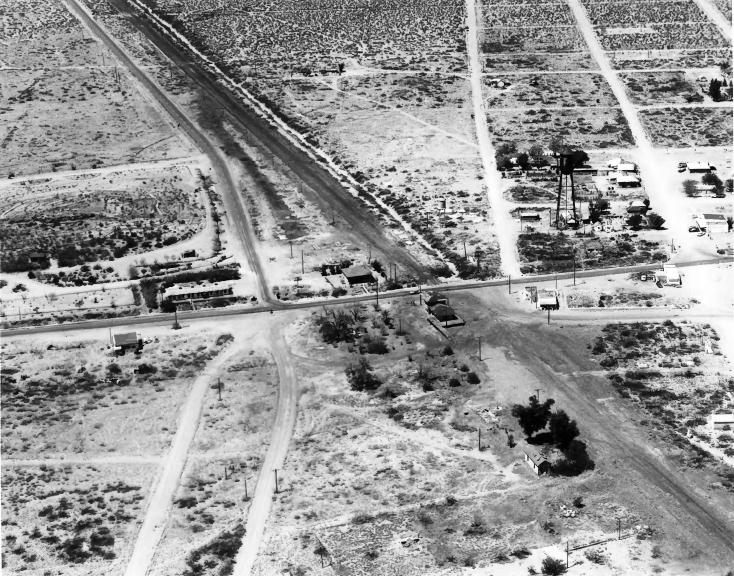 For a period in the Fifties Columbus was described in guidebooks as "abandoned" after the rail service ended and the town deteriorated badly.
 You can see from these pictures, taken in the 1970s as support for declaring the town and the remains of Camp Furlong a "National Historic Place", just how badly the little town had fallen apart.
 The town has recovered...somewhat...today.
 The population, over 1,700 on the 2000 census, is now largely Hispanic (83% of the people living in Columbus is listed as "Hispanic or Latino of any race"), young (almost 2 out of five below the age of 18), and poor. The per capita income for the village was $6,721, and about 57% of families were living below the U.S. federal poverty line.
What I find particularly interesting is that, long after being chased across the border well whipped, the old caudillo of Chihuahua seems to have won in the end.
The now-mostly-Mexican-American town of Columbus celebrates something called the Cabalgata Binacional Villista every 9th of March. This involves about 100 Mexican riders led by a Pancho look-a-like who follow Villa's invasion route across the border and parade into Columbus.
 The Mexicans are met at the border by a group of American riders and they trot to the Columbus plaza for a festival that includes trick riding and Mariachi music.
 Thousands of people are said to come from around the region. "This was our big historical moment. What better opportunity for a party?" asks one of the organizers, Linda Juarez.
Some of the older Columbus residents aren't as excited about all this Villaosity.
One man who says his great-grandfather was killed on 9 MAR, compares the party to feasting with bin Laden on September 11;
"I thought, "That's what happened here!" says Richard Dean, president of the Columbus Historical Society. Except for the scale of destruction, he says, the parallels "are mind-boggling": a sneak attack by a foreign insurgent who sought revenge for perceived injustices, and then vanished into forbidding terrain.Dean is frustrated that he can't get the State of Arizona to change the name of the park in Columbus. "Why name a park after a man who sacked the town and killed people?".
But the loud mariachis of the Cabalgata continue to drown out the attempts of the former town worthies, men like Dean, to turn thoughts to the Anglo dead and retake what was once fiercely theirs.
 These sons and grandsons of old Columbus find their ancestors' tombs untended and, behind their fortresslike wall, fear and hate a new generation of raiders.
It seems time, poverty, and lack of care will succeed where the guns of the División del Norte failed.
 Touchline Tattles: While the story of the original raid is just another page in the dreary, bloody story of the Mexican-American border and the Revolution of 1910, the story that has emerged from the little desert town 95 years later is almost good enough to be fiction.
Is seems that early this March the mayor of Columbus, its police chief, and a town councilman were among 11 Columbus residents indicted for purchasing and selling as many as 200 automatic and semiauto weapons. These included AKM machinepistols and (I'm guessing) 9mm Beretta service pistols, modern military arms for the wannabe Villista...because these munitions were being sold to the Mexican narcotraficantes; the soldiers of the drug cartels.
So after almost 100 years the guns go south again, to those who see themselves as modern rebels and latter-day Pancho Villas, whose bullets once again shake loose La Frontera, the unquiet border between the worlds.
 And behind the dusty veil of years, the ghosts of the tired troopers still sing as they march;
"We left the border for Parral
In search of Villa and Lopez, his old pal.
Our horses, they were hungry,
And we ate parched corn.
It was damn hard living
In the state of Chihuahua
Where Pancho Villa was born."

Saturday, February 5, 2011
Nothing Else Holds Fashion
I don't spend a lot of time worrying or wondering who reads this thing.
It's a hobby, like toy trains or dandruff, and like them I just enjoy fiddling with it for my own sake. If you enjoy reading it, well, fine. That's nice. But you note I don't have gimmicks like a pageview counter or stats showing on the pagefront.
So I was a little intrigued when I ambled over to my "stats" tab in the dashboard page for GFT. I spent some time noodling around finding out intriguingly useless stuff like the fact that someone from Brazil, Australia and India has stopped by to read my stuff, and that for some reason January was a huge month for pageviews.
But most intriguing and useless thing was that the second-ever-most viewed post was one titled "Hot for Something: Hakkaa päälle 2".
The most viewed was my Decisive Battles post for La Noche Triste, which I liked; I think that was a good post, the battle of the night of 30 JUN-1 JUL 1520 is both historically important and difficult to find a single good source for online, and the post itself is well written (in my unhumble opinion), a good reference for anyone interested in the event. Nice to know that other people seem to think so, too.
But the other?
It had something to do with education, I thought, since it was part two of another post that had ranted about the recent enthusiasm for deriving U.S. education "improvement" from places like Korea and Finland that were about as similar to the U.S. - any part of the U.S. - as chalk is to cheese. As usual, I argued, wheedled, ranted, discussed, and explained like a madman and got one lonely comment (thanks, tho, Lisa!). Nobody had any interest in discussing education, Finnish or otherwise, with me. I have no way of determining from the stats page but I'll bet that the first post has probably 34 pageviews including three or four from me editing the damn thing.
And yet the second post, which is this tiny little postscript, has something like 2,000 views, almost 1% of the total pageviews for the site in the past year or so.
WTF?
And then I opened the post are realized; it was the one I talked about Finland.
Tom of Finland.
"Lechery, lechery; still, wars and lechery; nothing else holds fashion: a burning devil take them!"
It is said that fame has its price. The price of mine appears to be gay pornography.
It's a hobby, like toy trains or dandruff, and like them I just enjoy fiddling with it for my own sake. If you enjoy reading it, well, fine. That's nice. But you note I don't have gimmicks like a pageview counter or stats showing on the pagefront.
So I was a little intrigued when I ambled over to my "stats" tab in the dashboard page for GFT. I spent some time noodling around finding out intriguingly useless stuff like the fact that someone from Brazil, Australia and India has stopped by to read my stuff, and that for some reason January was a huge month for pageviews.
But most intriguing and useless thing was that the second-ever-most viewed post was one titled "Hot for Something: Hakkaa päälle 2".
The most viewed was my Decisive Battles post for La Noche Triste, which I liked; I think that was a good post, the battle of the night of 30 JUN-1 JUL 1520 is both historically important and difficult to find a single good source for online, and the post itself is well written (in my unhumble opinion), a good reference for anyone interested in the event.
 Nice to know that other people seem to think so, too.
But the other?
It had something to do with education, I thought, since it was part two of another post that had ranted about the recent enthusiasm for deriving U.S. education "improvement" from places like Korea and Finland that were about as similar to the U.S. - any part of the U.S. - as chalk is to cheese. As usual, I argued, wheedled, ranted, discussed, and explained like a madman and got one lonely comment (thanks, tho, Lisa!). Nobody had any interest in discussing education, Finnish or otherwise, with me. I have no way of determining from the stats page but I'll bet that the first post has probably 34 pageviews including three or four from me editing the damn thing.
And yet the second post, which is this tiny little postscript, has something like 2,000 views, almost 1% of the total pageviews for the site in the past year or so.
WTF?
And then I opened the post are realized; it was the one I talked about Finland.
Tom of Finland.
"Lechery, lechery; still, wars and lechery; nothing else holds fashion: a burning devil take them!"
It is said that fame has its price.
 The price of mine appears to be gay pornography.
Tuesday, October 12, 2010
Decisive Battles: La Noche Triste 1520
First Tenochtitlan/"The Night of Sorrow" - Mexico City, Mexico Date: circa 30 JUN-1 JUL 1520 Forces Engaged: Spanish Expedition of Hernándo Cortés - On the Night of Sorrows the Spanish force was divided into a number of smaller units. According to Bernal Diaz (see below), the Spanish organization consisted of:
Point Element: About 15 mounted troops including many of Cortés' and the Narváez mounted captains and 100 footsoldiers.
Main Body: At least five separate elements, including -
a. the central maneuver unit; about 100 footsoldiers, probably with mounted officers under Pedro de Sandoval
b. the baggage train; 150 soldiers and 450 Tlaxcalan native troops
c. the artillery train; 50 cannoneers and 200 Tlaxcalans with somewhere between 10 and 12 small cannon including the powder and shot.
d. the prisoner escort; 30 soldiers, 300 Tlaxcalans guarding important Mexica hostages including the daughters of the former Hueyi Tlatoani, Motecuhzoma Xocoyotzin.
e. the captive rival: roughly 1,000 troops, horse and foot, under the Spanish officer Pánfilo de Narváez, who had been ambushed and defeated by Cortés the previous month while en route to arrest the expeditionary leader for treason and disobedience to the Governor of Cuba.
Rearguard: Daz says that "(t)he rear guard was composed of one hundred soldiers, mostly those of Narváez, and many cavalry (this was probably no more than 20-30 horsemen), under the command of Alvarado and Velasquez de Leon."
The Reaction Force: Cortés, at least 5-10 other mounted officers and 50 footsoldiers, "composed a reserve, to act wherever occasion should require." (Bernal Diaz)
Contemporary estimates approximately 1,300 Spanish soldiers and 2,000-4,000 Tlaxcalan native troops along with an unknown number (but probably several hundreds to one thousand total) of civilian servants, native porters, and Tlaxcalan families under the self-proclaimed Viceroy of New Spain, Hernándo (or Fernando) Cortés.
Imperial Aztec: Unknown, but a very large force, numbering probably in the tens of thousands of footsoldiers, many of them armed with both melee and projectile weapons. The names of the High General or Tlacochcalcatl and the Generals, or Tlācateccatli that night are not known. The overall war leader was the new Hueyi Tlatoani: Cuitláhuac.
So probably between 20,000 to 40,000 footsoldiers under several unknown commanders.
We should note here that the Mexica people of Tenochtitlan referred to themselves as Mexica Tenochca or Colhua-Mexica. "Aztec" is a Nahuatl word for the legendary origin of the Mexica, and the term is correctly applied only to the political union of the Mexica Tenochca with the Acolhuas of Texcoco and the Tepanecs of Tlacopan in the "Aztec Empire".
The Sources: As is the rule for most of the European imperial conquests of the Colonial Era we have little - nothing, really - that tells the Aztec/Mexica side of the tale. Several "codices" exist that were crafted by unknown Mexica scribes after the conquest was complete; the verity and originality - that is, the degree to which they tell the story of the native author and not the Spanish publisher - is questionable.
Possibly the single most influential source from the Aztec side is the so-called "Florentine Codex". This work was complied by the Franciscan Bernardino de Sahagún in the 1540s thru 1569 from interviews and accounts of the Nahuatl speakers of the Tlatelolco area. The twelve books of the "Historia general de las cosas de Nueva España" includes a grammar and dictionary of Náhuatl. A manuscript copy, probably prepared by several of Fr. Bernardino's trilingual Nahua apprentices reached Italy in 1588. The library where it is kept is in Firenze (Florence) which is the origin of the name.
This work is also the basis of Miguel León-Portilla's "Broken Spears: The Aztec Account of the Conquest of Mexico", among the better modern secondary sources for the Conquest.
We have no other verifiable native sources. So here we have an extreme case of the victor writing the history.
From the Spanish side we have several accounts of the Noche Triste.
Perhaps the closest we have to an "official" version is contained in the five "Cartas de relación" written by Cortés himself. However, these letters should be read with caution; they represent the expedition commander's attempt to propagandize the King of Spain into supporting him as the sole Spanish viceroy of the lands his forces had or were attempting to subdue. Several critical events and issues are either slanted to favor Cortés, omitted, or so variant from historical evidence from other sources as to be highly suspicious. Dr. Nancy Fitch has observed:
Even less reliable is the work of Francisco López de Gómara, chaplain to Cortés in the 1540s and 50s, whose "Hispania Victrix; First and Second Parts of the General History of the Indies, with the whole discovery and notable things that have happened since they were acquired until the year 1551, with the conquest of Mexico and New Spain" is a work of hagiography that was violently criticized by contemporary conquistadors such as Diaz.
This author, Bernal Díaz del Castillo, never published his manuscript "Historia verdadera de la conquista de la Nueva España" (The True History of the Conquest of New Spain). It was discovered in a library in Madrid in the 1600s. Diaz has his flaws; he was a footsoldier, a "rodelero" or sword-and-buckler-man, and he seems to have idolized the Great Man. He also writes a lot about the details of the others of his acquaintance, which provides some fascinating detail but as a result his prose does not flow. But he has a soldier's eye for detail, and many historians consider Diaz the most accurate and reliable source for the Spanish side of the Conquest.
Although his account was applicable to the effects of the Conquest on the lands of modern Mexico, Fr. Bartolomé de las Casas never visited the lands of New Spain during his years in the Western hemisphere. So though it is a useful tonic to the heroic narratives of the conquest, his "Brevísima relación de la destrucción de las Indias" (A Short Account of the Destruction of the Indies) sheds no light on the events of late June/early July.
Several worthwhile secondary accounts of the Conquest exist. These include the volume I encountered that nearly everyone cites as the "classic" account; W.H. Prescott's three volume "History of the Conquest of Mexico". Out of print and reported (by Dr. Fitch) as extremely Eurocentric, not surprising for a work printed in 1873. Other worthwhile works include Matt Restall's "Maya Conquistador", which brings in some Maya sources and Hugh Thomas' "Conquest: Montezuma, Cortés, and the Fall of Old Mexico", an excellent work of archival research.
The Conquest has been a rich vein for fiction, as well. Perhaps the most intriguing is Gary Jenning's "Aztec" which is replete with the most scandalous and appalling tales of war, politics, incest, human sacrifice...you name it, it's there. One thing to remember about Jennings, though; if you like a character, be sure he or she will die in the most horrible way possible..jpg)
For pure classic pulp, bodice-ripping, swashbuckling historical romance, you might try and find a secondhand copy of Sam Shellabarger's "Captain from Castile". Pure corn from the crib of the Hearty Imperialist school of fiction, full of villianous Aztecs, nubile and spirited girls, swordfights, suave but treacherous Dons, gentle friars, heroic conquerors, battles, rescues, and of course the noble Captain of the title. The book is a reminder of a different time when the good white people were born to rule the baser savages, but if you accept the faults it is entertaining for all that.
The film, despite the ornamentation of delicious Jean Peters (shown above with scrumptiously authentic 16th Century leg hair), is a complete turkey and should be avoided at all costs.
Consider yourself warned.
The Campaign: The causeway that led to the Noche Triste begins in the Spanish colony of Cuba in October of 1518. There the governor, Velázquez chose Hernándo (or Fernando; Cortés uses both spellings in contemprary documents. "Hernán" is a later abbreviation) Cortés to lead an expedition to trade with the coastal tribes of the landmass that had been first explored just the year before.
Cortés, though, conned Velázquez into inserting a clause into his orders that enabled Cortés to take "emergency measures" if such were "...in the true interests of the realm." Cortés' sailed in February 1518 with 11 ships, 530 soldiers (including 30 crossbowmen and 12 handgunners), at least eight women, a few hundred Cuban Indians and some African freedmen and slaves. Cortés spent the spring dicking around the Yucatán Peninsula, getting nowhere except in his encounter with the woman whom Cortés called Doña Marina, who is often known as Malinche, called by the Aztecs "Malintzin", and was probably born a Toltec or Tabascan noblewoman. She was sold as a slave to the newcomers, and though Cortés first handed her off to another of his officers he soon reclaimed her, both physically and organizationally.
Because, you see, Marina/Malinche gave him the key to the Azteca. She was both translator - he would speak to one of his troops, Gerónimo de Aguilar, in Spanish who would put the words to Malinche in Mayan, and she in turn would then translate from Mayan to Nahuatl, the language of the Aztecs - and advisor who knew how the natives of the Aztec Empire would respond to or anticipate his actions. Cortés' force finally came ashore near modern Veracruz in April, 1519. There he stumbled into the huge political opportunity that would eventually enable him to succeed in conquering the most powerful polity in native Central America.
The Aztecs weren't nice neighbors. Most of the Nahua polities outside the Aztec Empire proper were in one form or another pushed around by the Aztec. Whether in unfavorable trade, taxation, or in the peculiar guerrilla/low intensity/politico-religions "flowery wars" or xōchiyāōyōtl, the Aztecs had done little to endear themselves to either the Totonacs of the Veracruz region or the Tlaxcalans of the Sierra Madre Oriental. These peoples were more than willing to accept the help of the outsiders with the cool technology if it meant getting some licks on the Aztecs.
Starting from Tlaxcala in September the force, now augmented with between 1,000 to 4,000 native auxiliaries, fought its way up into the massif central and finally reached the Aztec/Mexica capital of Tenochtitlan on 8 NOV 1519. On the way they had taken time out to butcher much of the population of Cholula, the second largest city in preconquest Mesoamerica. There the Spanish killed many of the local "pili" - nobles - and fired the city. In the Cartes, Cortés says he slotted 3,000 in three hours; the details (how many were women or kiddies, whether the atrocity included rape and looting or was simple mass murder...) were not explained. Vazquez de Tapia was therem too, and later said he thought they had killed more like 30,000. Three thousand or thirty thousand, Cholula terrorized the locals and the Spanish were able to walk into the Mexica capital without a fight. Moctezuma greeted the invaders with gifts, put them up in his dad's palace, set their weird gods up in the main temple pyramid, and was rewarded by being taken prisoner and used to extort an immense golden ransom from the people of Mexica.
From the remove of almost five centuries and without the testimony of the Aztec ruler or his confidantes it is hard to figure just what Moctezuma was doing and why. Certainly it seems that we can discard the canard of "Cortés = Quetzalcoatl" legend and the similar tales of Aztec portents of pale, bearded gods from over the sea. These do not appear in any of the contemporary sources outside of the Cartas, which are explicitly intended to present the Aztecs as gullible savages.
The Mexica emperor had a vast army, the Aztec was a martial society...why didn't the Hueyi Tlatoani send his army out to meet the Spanish? Even more peculiar - why did he, in effect, invite the Spaniards to become the military rulers of the Empire?
Did he hope to use these foreigners? Was his plan to co-opt the invaders, perhaps even to get them to marry into his imperial line? Did he hope that he could swallow up the newcomers once he had them immured inside Tenochtitlan? We will never know. Whatever plan Moctezuma had fell apart when he was captured and died with him. But the effect was to immobilize the Aztec Empire just when the invaders were most insecure and vulnerable. So at this point we have Cortés and his merry gang of freebooters lording it up in the Mexica palaces, all winter and into the spring, eating, drinking, and probably screwing everything that moved - at least their commander did siring a total of five kiddies by five different women, including Marina and at least two of the Aztec ruler's daughters; honestly, the man was like a fucking goat.
It must have seemed like an idyll to the invaders, expecting hard fighting and instead finding riches and ease. So by spring 1520 everything was sunshine and happy puppies until...a runner from the coast arrived with word that a much larger party of Spaniards under the command of Pánfilo de Narváez had arrived in Veracruz with orders from Governor Velázquez to arrest Cortés for insubordination, mutiny, and treason.
Well, fuck.
Cortés reacted immediately; he left 140 troopers under Pedro de Alvarado to hold the capital and took 260 to tackle Narváez, who had between 900 and 1,100. Cortés force-marched back to the coast, launched a night attack on 24 MAY, took Narváez prisoner and disarmed his men. When Cortés told the Narváez group about the gold, slaves, and (from ol' Hernando, anyway) all those compliant Aztec hoochie mamas they deserted their general and followed Cortés back to Tenochtitlan in a heartbeat.
But back at the ranch, not all was well. Alvarado, you see, had gone a little goofy surrounded by the Mexica. When some 600 to 1,000 of the upper classes assembled for a celebratory dance to honor Huitzilopochtli in the Patio of the Gods of the main temple Alvarado and about 80 or 90 soldiers attacked.
This massacre was so brutally unnecessary that even the other Spanish were chapped. Here's López de Gómara:

Here's the Aztec account, from the Florentine Codex:
The Aztecs chose a new leader, Cuitláhuac; Cortés tried to restore the old order by getting Moctezuma address the crowd - he was jeered, stoned, and died within several days, whether from misery and his injuries or murdered by the Spanish, who had no more need for him we don't know. The Spanish found themselves besieged in their former guesthouse, and fought several major engagements, including a bloody sally into the main religious enclosure and an attack on the great temple pyramids. But by late in June things were getting desperate. The food inside the palace was running low, the powder as well, and given the overwhelming odds once the fighting became hand-to-hand it would be all over - the only hope was to break out. Diaz says that this was preceded by a bit of Spanish maskirova; Cortés attempted to mislead the Aztec leadership into the time of the maneuver:
The Engagement: The plan was that the expeditionary force would march out near midnight west, toward the Tlacopan causeway which is said to have been unguarded. Given the events of the night this is unlikely; it is more probable that the Mexica troops were bivouacked nearby with observation posts concealed in buildings overlooking the causeway emplaced to give warning if the invaders sallied.
It is likely that the bridging equipment lead the march so that the 16th Century Bailey Bridge could be placed across the first gap in the causeway (the Aztec troops having raised or broken the drawbridges normally in place) and the Spanish force cross over to the next stretch of causway, the bridge then moved up past the waiting force to the next gap.
This operation, conducted at night, by an unrehearsed force, would have been difficult even without armed opposition. But as it happened the opposition was not long in coming. Diaz tells the story: So much for "unguarded".
As with any military operation, whatever could go wrong did, and in this case early in the march. Diaz again:
The march column cannot maneuver, elements cannot support one another, while all are exposed to the the attacker's full force. There is no advantage of "interior lines", rather, it is the attacker who can move and attack more nimbly than the defender can adjust, if indeed they can respond at all. The causeway almost completely negated the Spanish cavalry, which could use neither height nor the mass, without lances unable to reach the warriors around them and unable to move beyond a walk and generate the momentum needed to knock their enemies over; the horsemen were a liability on the causeway in the dark. Add to this the rain, which neutralized the gunpowder weapons, the darkness, the failure of the mobile bridge, and the unfamiliarity of the Narváez group with Cortés' original troops, it is a tribute to the sheer fighting ferocity of the Spaniards that they managed any resistence at all.
But things did fall apart at the end. Here's Diaz on the last moments of many of the expedition: If you think about it for a moment you can almost picture what it must have been like; the march beginning with the fugitives a combination of fearful haste and frantic stealth, the confusion of the march column, then the alarms, the bridge failing, and then the arrows, spears and slingstones hissing out of the darkness and the boats full of warriors emerging from the curtains of rain.
I can't imagine which would have been worse; to have been in the part of the column attacked - men shouting and screaming, fighting, dying, horses shrieking, the orderly march dissolving into knots of struggling people - or to have been in the parts still waiting for the Mexica, hearing the sounds, clutching their weapons and staring into the rain and the night, trying to see the vast army all around them before they, too, were faced with their death rising out of the lake. It is difficult to know how many died, on the wet stones or in the bloody waters of Lake Texcoco that night. Diaz says that when the force made the shore of the lake near Tacuba Cortes took a small reaction force and turned back to see if he could rescue any of his troops. Just a short distance back down the causeway...
The fight wasn't over yet, either.
The Aztec pursuit continued through the following day and night as the Spanish rounded the west and then the north end of the lake, with harassing attacks picking off men and horses here and there. Finally the Spanish closed up at a place called Otumba, where they drove off a substantial Aztec force, killing its commander, and with that reminder of Spanish ferocity managed to secure some additional space to conduct a retreat to Tlaxcala. Diaz says of the losses of the Sorrowful Night and the battles that followed; "In five days were killed and sacrificed upwards of eight hundred and seventy soldiers, including seventy two of those of Narvaez put to death together with five Castilian women, in a place named Tustepeque. One thousand two hundred and upwards of our allies of Tlascala were also killed."
The Outcome: Decisive Aztec tactical victory
The Impact: Here's the thing I think when I consider the Sorrowful Night.
If ever there was a chance for the indigenous people of the Western hemisphere to have a chance to crush the invaders from across the eastern sea, it was there; that place, that night, that endless nightmare of a killing chute along the causeway to Tacloban when the maquahuitli came whirling out of the night and rain, when Spaniards and Tlaxcalans, men and women, died under the hail of spears, arrows, and slingstones.
That night in July 1520 the Mexica had all the advantages the native defenders would ever have; the rain and the causeway removed the advantages the Spanish got from their horsemen and their gunners. It was down to handstrokes, muscle and bone and steel against muscle and bone and volcanic glass, down to two nations ripe with bloodyhanded, violent men who both wanted the same thing; power. And in the end the Mexica couldn't finish the killing job, couldn't destroy the invaders.
Cortes and his core of hard men rode out of the end of the stone road, into another day of killing, and another, and another. The brilliant politician-soldier used the hatred the Aztec had laid for themselves, death by death, war by war, among their neighbors, until a year later he stood on the causeway again, regarding the enormous tomb that had been the city that had driven him out that night to weep under the ahuehuete tree with his Marina beside him for all those comrades, friends, and lovers ripped apart, dead and dying on the rain-sheeted stones or in the bloody waters of the lake behind him.
No, the decisiveness of the Noche Triste is in what it shows was just not possible; the inhabitants of the American mainland could not, bar a political, military, or immunological miracle, have resisted the European Conquest. As the Sorrowful Night, so every other attempt to resist the invaders, from "Anglo-Powhatan Wars" in Virgina to "King Philip's War" in Massachussetts
And from there to the open gates of the massive charnel house that was native America for the next 400 years was but the shortest of marches.
As short as the distance along the causeway from Tenochtitlan to Tacloban.
Some last thoughts on the Conquest: I wrote this post because of the recent passage of the 518th year since the arrival on America of the first of these invaders, Columbus and his crew. It has become fashionable to condemn Columbus, and in many, many ways he is, as both a man and a symbol of his class, culture, and times, utterly condemnable. He was a bad navigator, a poor administrator, and a callous slaver. It is understandable that a compassionate modern American might feel inclined to wish Columbus and his works to fuck off to hell. And in modern terms there IS no excuse for Columbus; he ushered in the frightfulness that was the Colonial Era, and would have done it again if he had known what he was going to do to the native population of the Americas; he was a man of his times, after all.
But in a sense, to blame Columbus the Man is to fail to grasp the real frightfulness of Columbus the Admiral of the Ocean Sea.
Because if Columbus had never been born someone else would have stood on that beach on San Salvador.
As with Columbus, Cortés. Had Cortés never been, another man like him, with his dreams of conquest and empire, would have stood up from under that tree near Tacuba to ride away and return to destroy the Aztec world.
While it is true that men and women make history, history as often makes the men and women it needs. The times and tides of history were mounting against the native peoples of the Americas that night. The battered Spanish and Tlaxcalan fugitives running through the Sorrowful Night were but the first spindrift, the almost imperceptible, feather-light spume of foam from the immense, implacable, ruthless European wave rising from the ocean behind them, a wave that would curl overhead and smash down in a surf of steel and fire and wash everything away in a rushing tide of blood.
There can be no question that the Spanish conquest of Mexico, and the European conquest of the Americans, was a tragedy for the people who lived here prior to 1492. But it's hard to untangle the past tragedy from the present. And finding a middle ground is frightfully difficult.
Take Doña Marina, La Malinche, born to the old world and yet the lover, companion, and mother of the new.
Many Mexicans consider her a sort of mother of their country, the mother of the admixture of Spanish and native American that is Mexico today.
But it is instructive to note that many others use the term "malinchista" (from La Malinche) to curse someone who is "un-Mexican", who despises their own culture. She is also sometimes referred to as "La Chingada", "The Fucked One", the implication obviously being that she, her son, and mestizo culture they stand for are the product not of love and cooperation but of rape - the rape of an entire world.
Perhaps its only if we take the long view that we can see the Conquest as just part of the history of the New World, and see the frightfulness of what was balanced by the fruitfulness of what is.
But to to that you have to look past a long, dark Sorrowful Night full of rain.
Touchline Tattles: One of the most peculiar and intriguing images to come out of the fusion of cultures that came about because the Spanish invaders survived La Noche Triste is called in Mexico "La mujer dormida"; "The sleeping woman".
She is always depicted as young and beautiful, and lying unconscious, typically draped in clinging gossamer that serves to emphasizes her feminine oomphyness. At her feet, or sometimes holding her in his arms is a picture-postcard Aztec warrior or chief, usually either looking upwards in supplication or down in grief. This image is one of the most common of the "Mexican" pictures painted on the walls of taquerias and torta places from Maine to Madagascar, as far as I can tell. You see it everywhere.
Supposedly it's some sort of legend about the volcanoes Popocatépetl and Iztaccíhuatl; the latter was a beautiful girl who loved an Aztec warrior and died of grief when she was maliciously told he had died in combat. He then returned, carried his love's body into the mountains where he ordered his warriors to build a funeral table with flowers and he put her on the top. There he knelt down to watch over her and died of grief as well.
I see this melodramatic image and think; Mexico has this rich, dramatic history full of adventure, romance, war, heroism, tragedy, betrayal...some of the greatest true stories in the world. And what do you pick to represent your height of romantic tragedy?
A hokey "legend" portrayed in pin-up images.
Let's face it. Nothing ever sells like a melodrama with a muscular hunk and a girl in scanty drapery. Spaniard, Aztec, or gringo, we all love our melodrama.
 Forces Engaged: Spanish Expedition of Hernándo Cortés - On the Night of Sorrows the Spanish force was divided into a number of smaller units. According to Bernal Diaz (see below), the Spanish organization consisted of:
Point Element: About 15 mounted troops including many of Cortés' and the Narváez mounted captains and 100 footsoldiers.
Main Body: At least five separate elements, including -
a. the central maneuver unit; about 100 footsoldiers, probably with mounted officers under Pedro de Sandoval
b. the baggage train; 150 soldiers and 450 Tlaxcalan native troops
c. the artillery train; 50 cannoneers and 200 Tlaxcalans with somewhere between 10 and 12 small cannon including the powder and shot.
d. the prisoner escort; 30 soldiers, 300 Tlaxcalans guarding important Mexica hostages including the daughters of the former Hueyi Tlatoani, Motecuhzoma Xocoyotzin.
e. the captive rival: roughly 1,000 troops, horse and foot, under the Spanish officer Pánfilo de Narváez, who had been ambushed and defeated by Cortés the previous month while en route to arrest the expeditionary leader for treason and disobedience to the Governor of Cuba.

Rearguard: Daz says that "(t)he rear guard was composed of one hundred soldiers, mostly those of Narváez, and many cavalry (this was probably no more than 20-30 horsemen), under the command of Alvarado and Velasquez de Leon."
The Reaction Force: Cortés, at least 5-10 other mounted officers and 50 footsoldiers, "composed a reserve, to act wherever occasion should require." (Bernal Diaz)
Contemporary estimates approximately 1,300 Spanish soldiers and 2,000-4,000 Tlaxcalan native troops along with an unknown number (but probably several hundreds to one thousand total) of civilian servants, native porters, and Tlaxcalan families under the self-proclaimed Viceroy of New Spain, Hernándo (or Fernando) Cortés.
Imperial Aztec: Unknown, but a very large force, numbering probably in the tens of thousands of footsoldiers, many of them armed with both melee and projectile weapons. The names of the High General or Tlacochcalcatl and the Generals, or Tlācateccatli that night are not known. The overall war leader was the new Hueyi Tlatoani: Cuitláhuac.

So probably between 20,000 to 40,000 footsoldiers under several unknown commanders.
We should note here that the Mexica people of Tenochtitlan referred to themselves as Mexica Tenochca or Colhua-Mexica. "Aztec" is a Nahuatl word for the legendary origin of the Mexica, and the term is correctly applied only to the political union of the Mexica Tenochca with the Acolhuas of Texcoco and the Tepanecs of Tlacopan in the "Aztec Empire".
The Sources: As is the rule for most of the European imperial conquests of the Colonial Era we have little - nothing, really - that tells the Aztec/Mexica side of the tale. Several "codices" exist that were crafted by unknown Mexica scribes after the conquest was complete; the verity and originality - that is, the degree to which they tell the story of the native author and not the Spanish publisher - is questionable.
Possibly the single most influential source from the Aztec side is the so-called "Florentine Codex". This work was complied by the Franciscan Bernardino de Sahagún in the 1540s thru 1569 from interviews and accounts of the Nahuatl speakers of the Tlatelolco area.
 The twelve books of the "Historia general de las cosas de Nueva España" includes a grammar and dictionary of Náhuatl. A manuscript copy, probably prepared by several of Fr. Bernardino's trilingual Nahua apprentices reached Italy in 1588. The library where it is kept is in Firenze (Florence) which is the origin of the name.
This work is also the basis of Miguel León-Portilla's "Broken Spears: The Aztec Account of the Conquest of Mexico", among the better modern secondary sources for the Conquest.
We have no other verifiable native sources. So here we have an extreme case of the victor writing the history.
From the Spanish side we have several accounts of the Noche Triste.
Perhaps the closest we have to an "official" version is contained in the five "Cartas de relación" written by Cortés himself.
 However, these letters should be read with caution; they represent the expedition commander's attempt to propagandize the King of Spain into supporting him as the sole Spanish viceroy of the lands his forces had or were attempting to subdue. Several critical events and issues are either slanted to favor Cortés, omitted, or so variant from historical evidence from other sources as to be highly suspicious. Dr. Nancy Fitch has observed:
 "But during much of the conquest, Cortés’s letters could be interpreted as an attempt to justify his deliberate failure to obey Diego Velázquez de Cellar, the Spanish governor in Cuba, the sponsor of his expedition. The published first letter was, in fact, not Cortés’s original letter, but one revised by a committee with the deliberate intention of positively influencing Charles V."Of the five, the first, as noted above, has been lost and, regardless, seems to have been dated in 1519. The fifth deals with an expedition to what is now Honduras in the mid 1520s. So the three cartas that deal with the battle on the night of 30 JUN/1JUL are the Second, dated October 30, 1520, the Third, dated May 15, 1522, and the Fourth, dated October 20, 1524. These letters are online in Spanish here, and are also accessible in English in several print volumes. Not surprisingly, Cortés gives few details about the engagement, perhaps the most damaging of the expedition and his only significant defeat.
Even less reliable is the work of Francisco López de Gómara, chaplain to Cortés in the 1540s and 50s, whose "Hispania Victrix; First and Second Parts of the General History of the Indies, with the whole discovery and notable things that have happened since they were acquired until the year 1551, with the conquest of Mexico and New Spain" is a work of hagiography that was violently criticized by contemporary conquistadors such as Diaz.
This author, Bernal Díaz del Castillo, never published his manuscript "Historia verdadera de la conquista de la Nueva España" (The True History of the Conquest of New Spain). It was discovered in a library in Madrid in the 1600s. Diaz has his flaws; he was a footsoldier, a "rodelero" or sword-and-buckler-man, and he seems to have idolized the Great Man. He also writes a lot about the details of the others of his acquaintance, which provides some fascinating detail but as a result his prose does not flow. But he has a soldier's eye for detail, and many historians consider Diaz the most accurate and reliable source for the Spanish side of the Conquest.
Although his account was applicable to the effects of the Conquest on the lands of modern Mexico, Fr. Bartolomé de las Casas never visited the lands of New Spain during his years in the Western hemisphere. So though it is a useful tonic to the heroic narratives of the conquest, his "Brevísima relación de la destrucción de las Indias" (A Short Account of the Destruction of the Indies) sheds no light on the events of late June/early July.
Several worthwhile secondary accounts of the Conquest exist. These include the volume I encountered that nearly everyone cites as the "classic" account; W.H. Prescott's three volume "History of the Conquest of Mexico". Out of print and reported (by Dr. Fitch) as extremely Eurocentric, not surprising for a work printed in 1873. Other worthwhile works include Matt Restall's "Maya Conquistador", which brings in some Maya sources and Hugh Thomas' "Conquest: Montezuma, Cortés, and the Fall of Old Mexico", an excellent work of archival research.
The Conquest has been a rich vein for fiction, as well. Perhaps the most intriguing is Gary Jenning's "Aztec" which is replete with the most scandalous and appalling tales of war, politics, incest, human sacrifice...you name it, it's there. One thing to remember about Jennings, though; if you like a character, be sure he or she will die in the most horrible way possible.
.jpg)
For pure classic pulp, bodice-ripping, swashbuckling historical romance, you might try and find a secondhand copy of Sam Shellabarger's "Captain from Castile". Pure corn from the crib of the Hearty Imperialist school of fiction, full of villianous Aztecs, nubile and spirited girls, swordfights, suave but treacherous Dons, gentle friars, heroic conquerors, battles, rescues, and of course the noble Captain of the title. The book is a reminder of a different time when the good white people were born to rule the baser savages, but if you accept the faults it is entertaining for all that.
The film, despite the ornamentation of delicious Jean Peters (shown above with scrumptiously authentic 16th Century leg hair), is a complete turkey and should be avoided at all costs.
Consider yourself warned.
The Campaign: The causeway that led to the Noche Triste begins in the Spanish colony of Cuba in October of 1518. There the governor, Velázquez chose Hernándo (or Fernando; Cortés uses both spellings in contemprary documents. "Hernán" is a later abbreviation) Cortés to lead an expedition to trade with the coastal tribes of the landmass that had been first explored just the year before.
Cortés, though, conned Velázquez into inserting a clause into his orders that enabled Cortés to take "emergency measures" if such were "...in the true interests of the realm." Cortés' sailed in February 1518 with 11 ships, 530 soldiers (including 30 crossbowmen and 12 handgunners), at least eight women, a few hundred Cuban Indians and some African freedmen and slaves.
 Cortés spent the spring dicking around the Yucatán Peninsula, getting nowhere except in his encounter with the woman whom Cortés called Doña Marina, who is often known as Malinche, called by the Aztecs "Malintzin", and was probably born a Toltec or Tabascan noblewoman. She was sold as a slave to the newcomers, and though Cortés first handed her off to another of his officers he soon reclaimed her, both physically and organizationally.
Because, you see, Marina/Malinche gave him the key to the Azteca. She was both translator - he would speak to one of his troops, Gerónimo de Aguilar, in Spanish who would put the words to Malinche in Mayan, and she in turn would then translate from Mayan to Nahuatl, the language of the Aztecs - and advisor who knew how the natives of the Aztec Empire would respond to or anticipate his actions.
 Cortés' force finally came ashore near modern Veracruz in April, 1519. There he stumbled into the huge political opportunity that would eventually enable him to succeed in conquering the most powerful polity in native Central America.
The Aztecs weren't nice neighbors.
 Most of the Nahua polities outside the Aztec Empire proper were in one form or another pushed around by the Aztec. Whether in unfavorable trade, taxation, or in the peculiar guerrilla/low intensity/politico-religions "flowery wars" or xōchiyāōyōtl, the Aztecs had done little to endear themselves to either the Totonacs of the Veracruz region or the Tlaxcalans of the Sierra Madre Oriental. These peoples were more than willing to accept the help of the outsiders with the cool technology if it meant getting some licks on the Aztecs.
Starting from Tlaxcala in September the force, now augmented with between 1,000 to 4,000 native auxiliaries, fought its way up into the massif central and finally reached the Aztec/Mexica capital of Tenochtitlan on 8 NOV 1519. On the way they had taken time out to butcher much of the population of Cholula, the second largest city in preconquest Mesoamerica. There the Spanish killed many of the local "pili" - nobles - and fired the city. In the Cartes, Cortés says he slotted 3,000 in three hours; the details (how many were women or kiddies, whether the atrocity included rape and looting or was simple mass murder...) were not explained. Vazquez de Tapia was therem too, and later said he thought they had killed more like 30,000.
 Three thousand or thirty thousand, Cholula terrorized the locals and the Spanish were able to walk into the Mexica capital without a fight. Moctezuma greeted the invaders with gifts, put them up in his dad's palace, set their weird gods up in the main temple pyramid, and was rewarded by being taken prisoner and used to extort an immense golden ransom from the people of Mexica.
From the remove of almost five centuries and without the testimony of the Aztec ruler or his confidantes it is hard to figure just what Moctezuma was doing and why. Certainly it seems that we can discard the canard of "Cortés = Quetzalcoatl" legend and the similar tales of Aztec portents of pale, bearded gods from over the sea. These do not appear in any of the contemporary sources outside of the Cartas, which are explicitly intended to present the Aztecs as gullible savages.
The Mexica emperor had a vast army, the Aztec was a martial society...why didn't the Hueyi Tlatoani send his army out to meet the Spanish? Even more peculiar - why did he, in effect, invite the Spaniards to become the military rulers of the Empire?
Did he hope to use these foreigners? Was his plan to co-opt the invaders, perhaps even to get them to marry into his imperial line? Did he hope that he could swallow up the newcomers once he had them immured inside Tenochtitlan? We will never know. Whatever plan Moctezuma had fell apart when he was captured and died with him. But the effect was to immobilize the Aztec Empire just when the invaders were most insecure and vulnerable.
 So at this point we have Cortés and his merry gang of freebooters lording it up in the Mexica palaces, all winter and into the spring, eating, drinking, and probably screwing everything that moved - at least their commander did siring a total of five kiddies by five different women, including Marina and at least two of the Aztec ruler's daughters; honestly, the man was like a fucking goat.
 It must have seemed like an idyll to the invaders, expecting hard fighting and instead finding riches and ease. So by spring 1520 everything was sunshine and happy puppies until...a runner from the coast arrived with word that a much larger party of Spaniards under the command of Pánfilo de Narváez had arrived in Veracruz with orders from Governor Velázquez to arrest Cortés for insubordination, mutiny, and treason.
Well, fuck.

Cortés reacted immediately; he left 140 troopers under Pedro de Alvarado to hold the capital and took 260 to tackle Narváez, who had between 900 and 1,100. Cortés force-marched back to the coast, launched a night attack on 24 MAY, took Narváez prisoner and disarmed his men. When Cortés told the Narváez group about the gold, slaves, and (from ol' Hernando, anyway) all those compliant Aztec hoochie mamas they deserted their general and followed Cortés back to Tenochtitlan in a heartbeat.
But back at the ranch, not all was well. Alvarado, you see, had gone a little goofy surrounded by the Mexica. When some 600 to 1,000 of the upper classes assembled for a celebratory dance to honor Huitzilopochtli in the Patio of the Gods of the main temple Alvarado and about 80 or 90 soldiers attacked.
This massacre was so brutally unnecessary that even the other Spanish were chapped. Here's López de Gómara:
"The songs were sacred, and not profane, and were sung to praise the god honored in the festival, to induce him to provide water and grain, health, and victory, or to thank him for healthy children and other things."

"While the Mexica gentlemen were dancing in the temple yard of Vitcilopuchtli [Huitzilopochtli], Pedro de Alvarado went there. Whether on [the basis of] his own opinion or in an agreement decided by everyone, I don't know, but some say he had been warned that the Indian nobles of the city had assembled to plot the mutiny and the rebellion, which they later carried out; others, believe that [the Spaniards] went to watch them perform this famous and praised dance, and seeing how rich they were and wanting the gold the Indians were wearing, he [Alvarado] covered each of the entrances with ten or twelve Spaniards and went inside with more than fifty [Spaniards], and without remorse and lacking any Christian piety, they brutally stabbed and killed the Indians, and took what they were wearing."
Here's the Aztec account, from the Florentine Codex:
"At that moment, they then attacked all the people, stabbing them, spearing them, wounding them with their swords. They struck some from behind, who fell instantly to the ground with their entrails hanging out [of their bodies]. They cut off the heads of some and smashed the heads of others into little pieces."

"They struck others in the shoulders and tore their arms from their bodies. They struck some in the thighs and some in the calves. They slashed others in the abdomen and their entrails fell to the earth. There were some who even ran in vain, but their bowels spilled as they ran; they seemed to get their feet entangled with their own entrails. Eager to flee, they found nowhere to go. Some tried to escape, but the Spaniards murdered them at the gates while they laughed. Others climbed the walls, but they could not save themselves. Others entered the communal house, where they were safe for a while. Others lay down among the victims and pretended to be dead. But if they stood up again they [the Spaniards] would see them and kill them."Whatever the reason for the butchery, when the newly combined groups of Spanish returned to the city they found not a resort full of food, gold, and easy women but and angry mob led by thousands of Aztec soldiers.
The Aztecs chose a new leader, Cuitláhuac; Cortés tried to restore the old order by getting Moctezuma address the crowd - he was jeered, stoned, and died within several days, whether from misery and his injuries or murdered by the Spanish, who had no more need for him we don't know. The Spanish found themselves besieged in their former guesthouse, and fought several major engagements, including a bloody sally into the main religious enclosure and an attack on the great temple pyramids.
 But by late in June things were getting desperate. The food inside the palace was running low, the powder as well, and given the overwhelming odds once the fighting became hand-to-hand it would be all over - the only hope was to break out. Diaz says that this was preceded by a bit of Spanish maskirova; Cortés attempted to mislead the Aztec leadership into the time of the maneuver:
 "...it was determined by Cortes and all of the officers and soldiers, to quit the city during the night, as we hoped at that time to find the enemy less alert, in order to put them the more off their guard, we sent a message by a chief priest, informing them, that if we were permitted to quit the city unmolested within the space of eight days, we would surrender all the gold which was in our possession."
The Engagement: The plan was that the expeditionary force would march out near midnight west, toward the Tlacopan causeway which is said to have been unguarded. Given the events of the night this is unlikely; it is more probable that the Mexica troops were bivouacked nearby with observation posts concealed in buildings overlooking the causeway emplaced to give warning if the invaders sallied.
It is likely that the bridging equipment lead the march so that the 16th Century Bailey Bridge could be placed across the first gap in the causeway (the Aztec troops having raised or broken the drawbridges normally in place) and the Spanish force cross over to the next stretch of causway, the bridge then moved up past the waiting force to the next gap.
This operation, conducted at night, by an unrehearsed force, would have been difficult even without armed opposition. But as it happened the opposition was not long in coming. Diaz tells the story:
"A little before midnight the detachment which took charge of the portable bridge let out upon its march, and arriving at the first canal or aperture of water, it was thrown across. The night was dark and misty, and it began to rain. The bridge being fixed, the baggage, artillery, and some of the cavalry passed over it, as also the Tlascalans with the gold. Sandoval and those with him passed, also Cortes and his party after the first, and many other soldiers.
At this moment the trumpets and shouts of the enemy were heard, and the alarm was given by them, crying out, “Taltelulco, Taltelulco, out with your canoes! the Teules are going, attack them at the bridges.” In an instant the enemy were upon us by land, and the lake and canals were covered with canoes. They immediately flew to the bridges, and fell on us there, so that they entirely intercepted our line of march."
 So much for "unguarded".
As with any military operation, whatever could go wrong did, and in this case early in the march. Diaz again:
"As misfortunes do not come single, it also rained so heavily that some of the horses were terrifyed, and growing restive fell into the water, and the bridge was broken in at the same time. The enemy attacked us here now with redoubled fury, and our soldiers making a stout refinance, the aperture of water was soon filled with the dead and dying men, and horses, and those who were struggling to escape; all heaped together, with artillery, packs, and bales of baggage, and those who carried them. Many were drowned here, and many put into the canoes and carried off for sacrifice. It was dreadful to hear the cries of the unfortunate sufferers, calling for assistance and invoking the Holy Virgin or St. Jago, while others who escaped by swimming, or by clambering upon the chests, bales of baggage, and dead bodies, earnestly begged for help to get up to the causeway. Many who on their reaching the ground thought themselves safe, were there seized or knocked in the head with clubs."The march discipline fell apart; neither surprising nor a reflection on Spanish soldiering. From German forests to Korean mountains, being attacked in column in a restricted defile is perhaps the deadliest of all military positions for the defender.
The march column cannot maneuver, elements cannot support one another, while all are exposed to the the attacker's full force. There is no advantage of "interior lines", rather, it is the attacker who can move and attack more nimbly than the defender can adjust, if indeed they can respond at all. The causeway almost completely negated the Spanish cavalry, which could use neither height nor the mass, without lances unable to reach the warriors around them and unable to move beyond a walk and generate the momentum needed to knock their enemies over; the horsemen were a liability on the causeway in the dark.
 Add to this the rain, which neutralized the gunpowder weapons, the darkness, the failure of the mobile bridge, and the unfamiliarity of the Narváez group with Cortés' original troops, it is a tribute to the sheer fighting ferocity of the Spaniards that they managed any resistence at all.
But things did fall apart at the end. Here's Diaz on the last moments of many of the expedition:
"Away went whatever regularity had been in the march at first; for Cortes and the captains and soldiers who were mounted clapt spurs to their horses and gallopped off, along the causeway; nor can I blame them, for the cavalry could do nothing against the enemy, of any effect; for when they attacked them, the latter threw themselves into the water on each side the causeway, and others from the houses with arrows, or on the ground with large lances, killed the horses. It is evident we could make no battle with them in the water, and without powder, and in the night, what else could we do than what we did; which was, to join in bodies of thirty or forty soldiers, and when the Indians closed upon us, to drive them off with a few cuts and thrusts of our swords, and then hurry on, to get over the causeway as soon as we could. As to waiting for one another, that would have lost us all; and had it happened in the day time, things would have been even worse with us."
 If you think about it for a moment you can almost picture what it must have been like; the march beginning with the fugitives a combination of fearful haste and frantic stealth, the confusion of the march column, then the alarms, the bridge failing, and then the arrows, spears and slingstones hissing out of the darkness and the boats full of warriors emerging from the curtains of rain.
I can't imagine which would have been worse; to have been in the part of the column attacked - men shouting and screaming, fighting, dying, horses shrieking, the orderly march dissolving into knots of struggling people - or to have been in the parts still waiting for the Mexica, hearing the sounds, clutching their weapons and staring into the rain and the night, trying to see the vast army all around them before they, too, were faced with their death rising out of the lake.
 It is difficult to know how many died, on the wet stones or in the bloody waters of Lake Texcoco that night. Diaz says that when the force made the shore of the lake near Tacuba Cortes took a small reaction force and turned back to see if he could rescue any of his troops. Just a short distance back down the causeway...
"...they met P. de Alvarado with his lance in his hand, badly wounded, and on foot, for his chesnut mare had been killed; he had with him three of our soldiers, and four of those of Narvaez, all badly wounded, and eight Tlascalans covered with blood." (Diaz)Remember that Alvarado was the commander of the trail element; about 100 footsoldiers and as many as 30 horsemen. So by this point the rearguard had lost 93 out of 100 infantry, all the cavalry save Alvarado himself, and had managed to pick up a handful of loose Tlaxscalan survivors from the main element.
The fight wasn't over yet, either.
The Aztec pursuit continued through the following day and night as the Spanish rounded the west and then the north end of the lake, with harassing attacks picking off men and horses here and there. Finally the Spanish closed up at a place called Otumba, where they drove off a substantial Aztec force, killing its commander, and with that reminder of Spanish ferocity managed to secure some additional space to conduct a retreat to Tlaxcala.
 Diaz says of the losses of the Sorrowful Night and the battles that followed; "In five days were killed and sacrificed upwards of eight hundred and seventy soldiers, including seventy two of those of Narvaez put to death together with five Castilian women, in a place named Tustepeque. One thousand two hundred and upwards of our allies of Tlascala were also killed."
The Outcome: Decisive Aztec tactical victory
The Impact: Here's the thing I think when I consider the Sorrowful Night.

If ever there was a chance for the indigenous people of the Western hemisphere to have a chance to crush the invaders from across the eastern sea, it was there; that place, that night, that endless nightmare of a killing chute along the causeway to Tacloban when the maquahuitli came whirling out of the night and rain, when Spaniards and Tlaxcalans, men and women, died under the hail of spears, arrows, and slingstones.
That night in July 1520 the Mexica had all the advantages the native defenders would ever have; the rain and the causeway removed the advantages the Spanish got from their horsemen and their gunners. It was down to handstrokes, muscle and bone and steel against muscle and bone and volcanic glass, down to two nations ripe with bloodyhanded, violent men who both wanted the same thing; power.
 And in the end the Mexica couldn't finish the killing job, couldn't destroy the invaders.
 Cortes and his core of hard men rode out of the end of the stone road, into another day of killing, and another, and another. The brilliant politician-soldier used the hatred the Aztec had laid for themselves, death by death, war by war, among their neighbors, until a year later he stood on the causeway again, regarding the enormous tomb that had been the city that had driven him out that night to weep under the ahuehuete tree
 with his Marina beside him for all those comrades, friends, and lovers ripped apart, dead and dying on the rain-sheeted stones or in the bloody waters of the lake behind him.
No, the decisiveness of the Noche Triste is in what it shows was just not possible; the inhabitants of the American mainland could not, bar a political, military, or immunological miracle, have resisted the European Conquest. As the Sorrowful Night, so every other attempt to resist the invaders, from "Anglo-Powhatan Wars" in Virgina to "King Philip's War" in Massachussetts
And from there to the open gates of the massive charnel house that was native America for the next 400 years was but the shortest of marches.
As short as the distance along the causeway from Tenochtitlan to Tacloban.
Some last thoughts on the Conquest: I wrote this post because of the recent passage of the 518th year since the arrival on America of the first of these invaders, Columbus and his crew. It has become fashionable to condemn Columbus, and in many, many ways he is, as both a man and a symbol of his class, culture, and times, utterly condemnable. He was a bad navigator, a poor administrator, and a callous slaver. It is understandable that a compassionate modern American might feel inclined to wish Columbus and his works to fuck off to hell.
 And in modern terms there IS no excuse for Columbus; he ushered in the frightfulness that was the Colonial Era, and would have done it again if he had known what he was going to do to the native population of the Americas; he was a man of his times, after all.
But in a sense, to blame Columbus the Man is to fail to grasp the real frightfulness of Columbus the Admiral of the Ocean Sea.
Because if Columbus had never been born someone else would have stood on that beach on San Salvador.
As with Columbus, Cortés. Had Cortés never been, another man like him, with his dreams of conquest and empire, would have stood up from under that tree near Tacuba to ride away and return to destroy the Aztec world.
While it is true that men and women make history, history as often makes the men and women it needs. The times and tides of history were mounting against the native peoples of the Americas that night. The battered Spanish and Tlaxcalan fugitives running through the Sorrowful Night were but the first spindrift, the almost imperceptible, feather-light spume of foam from the immense, implacable, ruthless European wave rising from the ocean behind them, a wave that would curl overhead and smash down in a surf of steel and fire and wash everything away in a rushing tide of blood.
There can be no question that the Spanish conquest of Mexico, and the European conquest of the Americans, was a tragedy for the people who lived here prior to 1492. But it's hard to untangle the past tragedy from the present.
 And finding a middle ground is frightfully difficult.
Take Doña Marina, La Malinche, born to the old world and yet the lover, companion, and mother of the new.

Many Mexicans consider her a sort of mother of their country, the mother of the admixture of Spanish and native American that is Mexico today.
But it is instructive to note that many others use the term "malinchista" (from La Malinche) to curse someone who is "un-Mexican", who despises their own culture. She is also sometimes referred to as "La Chingada", "The Fucked One", the implication obviously being that she, her son, and mestizo culture they stand for are the product not of love and cooperation but of rape - the rape of an entire world.
Perhaps its only if we take the long view that we can see the Conquest as just part of the history of the New World, and see the frightfulness of what was balanced by the fruitfulness of what is.
But to to that you have to look past a long, dark Sorrowful Night full of rain.
Touchline Tattles: One of the most peculiar and intriguing images to come out of the fusion of cultures that came about because the Spanish invaders survived La Noche Triste is called in Mexico "La mujer dormida"; "The sleeping woman".
She is always depicted as young and beautiful, and lying unconscious, typically draped in clinging gossamer that serves to emphasizes her feminine oomphyness. At her feet, or sometimes holding her in his arms is a picture-postcard Aztec warrior or chief, usually either looking upwards in supplication or down in grief.
 This image is one of the most common of the "Mexican" pictures painted on the walls of taquerias and torta places from Maine to Madagascar, as far as I can tell. You see it everywhere.
Supposedly it's some sort of legend about the volcanoes Popocatépetl and Iztaccíhuatl; the latter was a beautiful girl who loved an Aztec warrior and died of grief when she was maliciously told he had died in combat. He then returned, carried his love's body into the mountains where he ordered his warriors to build a funeral table with flowers and he put her on the top. There he knelt down to watch over her and died of grief as well.
I see this melodramatic image and think; Mexico has this rich, dramatic history full of adventure, romance, war, heroism, tragedy, betrayal...some of the greatest true stories in the world. And what do you pick to represent your height of romantic tragedy?
A hokey "legend" portrayed in pin-up images.
Let's face it. Nothing ever sells like a melodrama with a muscular hunk and a girl in scanty drapery. Spaniard, Aztec, or gringo, we all love our melodrama.
Subscribe to:
Posts (Atom)