Since "We Are At War", a little reminder of...well, real war."Because that stable in Bethlehem was a 'shelter', too..."
All the presents are wrapped, the Christmas roast beef consumed, the Littles are entertaining themselves while taunting their parents by watching one of those appalling "Chipmunks" movies (dear God!) and my bride is finishing binding the edge of a quilt. I'm looking up bizarre Christmas videos on YouTube (the Nazi one is...strange). We're an exciting group here at the Fire Direction Center.
I still find the entire business of our "Christmas" strange; a glittery ornament that is completely hollow inside.
I still have not a shred of faith, other than my usual bitter amusement at the ability of my fellow hairless chimps to find justification for their most self-serving actions in tales of a magical Judean two thousand years old.
My bride is, so far as I know, even less religious than I am; while I have a certain lingering affection for and admiration of those who genuinely live the tenets of their faiths (whatever those faiths may be) she has said that she considers the entire nonsense a sort of nonprofit scam at best. I try and tell the kiddos that the stories of Jesus and Muhammad and Abraham are no less "real" than those of Santa and Ebenezer Scrooge - that while I don't believe in them I don't know that they're "wrong" anymore than the religious people who tell them "know" they're right.
Mojo just laughs and tells the littles that it's all a big ball of styrofoam packing peanuts, a whole bunch of hooey.
And the small ones, they are at the stage where laughing and mocking the old Bible stories seems daring and funny.
So...why bother?
Presents.
If I had any more respect for the institution of the Papacy than I have for the North American Man-Boy Love Association and Bank of America combined I would be tempted to apologize to Bennie Sixteen. He's pretty much got us pegged. We're in it for the bling, baby. If my kiddos had been there in that stable two thousand and forty-three years ago they'd have tossed li'l Jesus out of the manger looking for one more prezzie. He would have been so much detritus around what they consider important to the day and, besides, as Missy herself would advise you: "Babies are stupid!"
Well.
Regardless of our impiety and our disregard for the "reason for the season" this time of year is traditionally also supposed to be about loving and caring for others. And as I am here surrounded by those I love I hope you and those you love are together, or, if not, at peace and in harmony tonight. I hope tomorrow, whether you're waking for a holiday or just for another Sunday, brings you challenge and fulfillment, joy and contentment.
And Baby Jesus? Well, if He is why you're celebrating today I sincerely hope you find him, in the day, in your loved ones, in your world, in your hearts. As the Chipmunks would say; me, I want a hula hoop.
G'night.
Showing posts with label old movies. Show all posts
Showing posts with label old movies. Show all posts
Saturday, December 24, 2011

Tuesday, December 7, 2010
Chestnuts Roasting I: Miracle on 34th Street
As John Lennon used to say: "So this is Christmas..." Eric Idle...ummm, didn't say it quite that way.
You know how I feel about this whole business. I'm more with Idle than with Lennon.
Mind you, my likes and dislikes don't really matter. We've had Christmas this and Christmas that and Christmas the other damn thing since practically Halloween. But now that we're on the dark side of Thanksgiving, well...
This year is turning out to be interesting, however. The kiddos are caught up in the usual Christmas greed, obediently parroting the gimme paternoster at every huckster on the television. Missy, especially, is turning out to be a sucker for cheap, shiny plastic crap. A commercial for anything aimed at kids, from Benadroos to Bandryl will produce her immediate Pavlovian "IwantthatcanIhavethatwillyougetmethat?" She's not completely unreasonable - there are no tantrums or tears if she hears "no", but through repetition this does not become endearing.
The Peep, who at seven-and-a-half is a more experienced consumer, has opted for quality over quantity and wants only the largest and most costly Lego toys. These, by the way, I am now utterly unwilling to provide to him based on bitter experience. As objects the damn things are fiendishly expensive; as toys, completely worthless, being both heavy and fragile. The disassociated pieces of but the "Republic Attack Shuttle" and the "AT-TE" walker ,now intermingled with a dozen other smaller Lego objects, stand mute witness to this. His grandparents can bankroll his Lego addiction, if they want. I'm getting him a bicycle.
Oh, and he has decided he doesn't want to kill a tree for Santa. He wants to get a fake tree. No pink ones, mind, and it can't be plaid or otherwise obviously "fake-y". But he wants to get a plain green fake tree. And it can't be before...
Christmas Eve.
I'm tempted to go with it just to see what happens. And then dance an antic hay on the ruins. It'd be the Perfectly Awful Christmas.
But then there's being the grown-up thing. Sigh.
Of course, the other inescapable element of Wenceslausery is the sudden metastasizing Christmas specials and Christmas movies and Christmas television episodes.
Don't mistake me; like any kid of the Video Era I grew up with the idea that television, not the angel of Bethlehem, announced the Savior's Birth. I was raised on Christmas commercials, Rudolph, Charlie Brown, and the Grinch (although I am glad that I am too old to have my eyes seared with the awful Ron Howard/Jim Carrey live-action version; talk about a childhood trauma...) as more important to the Greatest Story ever told as the Big Guy from little Galilee. In fact, I would say that my "Christmas" - the ideas and images that made the holiday a reality for me - came from the cathode ray tube rather than the Bible, the church, or the stories.
Perhaps one of my favorite celluloid Christmases is the one in the George Seaton "Miracle on 34th Street".
C'mon, I know you've seen this thing. It may be the biggest Christmas chestnut after "It's a Wonderful Life", and it's certainly less glurgeworthy. It's a breezy confection of a yarn, with Ed Gwenn as the whiskered gentleman that everyone doesn't quite want to believe is really Santa Claus. John Payne makes a sensible good fellow of a hero as Fred the attorney who defends "Kris Kringle", Maureen O'Hara a gloriously mature and completely desirable Doris, the Macy's executive whose little girl Susan is the pivot on whom the movie turns. Susan, played by a dark and brilliant young Natalie Wood, is the perfect center; wise and foolish, cautious and loving, skeptical and credulous. As a kid she's the cool big sister you wish you had, as an adult, the bright, loving little daughter. And, of course, the movie is full of great little bits of work. Gwenn discovering what people with beards shouldn't blow bubble gum. "Susan" is full of inside knowledge on the Macy's Thanksgiving parade she's picked up from her mother, who has organized it for all her young life. The brilliant gimmick that lets Fred "prove" Kris is THE Santa Claus through the inspiration of the overworked mail sorter who convinces his foreman to send "all them Santy Claus letters" to the courthouse.
 It's practically perfect; gently sentimental without treacle, loving and respecting its holiday without glurge. It's one of the few Christmas pictures I can sit through without wincing.
Oh, and did you know that 20th Century released it in May? Seriously. Weird, yes, but there it is: May 2, 1947. You can look it up. Now this is America. And as you know, here if something works once, that means it needs to be done over. And bigger. With more stuff. And preferably in color.
And that's what happened to "Miracle". Actually, it happened FIVE times; two one-hour television versions in the Fifties, a musical in the Sixties (but all sorts of awful musicals happened in the Sixties, so it wasn't exactly the worst of its type...), a TV movie in the Seventies, and, finally, a theatrical movie in the Nineties.
The 1994 movie version, for some reason, has been in heavy rotation on the usual calbe channel suspects lately; Lifetime, "Family", Hallmark. Its really kind of intriguing, in a sort of true-crime-story way, to see the difference between the America that had just emerged from the abyss of World War 2 and the one that was the Sole Superpower, the Indispensable Nation, the gigantic economic and political colossus then at the height of its power and wealth. The players are all there; Richard Attenborough as Kris, trying to look Gwennishly charming and succeeding in looking merely dyspeptic. Dylan McDermot replaces Payne, looking more intent but less decent. Elizabeth Perkins, whose ability to play vulnerably intelligent women I truly enjoy, does so here and deftly as always. Mara Wilson does a decent job as Susan, although she never manages Wood's luminosity or her skeptical intelligence (which is a problem, because the story calls for convincing the prenaturally adult Wood to feel and love childishly to be a Santaesque labor, whereas Wilson comes off as just a nice kiddo).
John Hughes directs.
That's not the problem.
The problem is that the story was perfectly suited for the sunny, lighthearted good sense of the Forties. The original never felt strained, never lectured, never brooded or pouted. It was a straightforward tale of whimsy, well-told, but with a good-humored wink towards the audience.
The Nineties version has none of this. It is uneven in tone, sometimes childishly callow, sometimes cynical, and adds a disturbingly strong, wildly out-of-place thread of religious piety to the plot, disturbing since the entire story is based on the central reality of that very Anti-Christ of American commercial Christmas, Santa Claus.
I should add that the religiousness comes across to me as rather mean-spirited, not presented as a sort of warm God-fuzzy but rather as a failure on the part of the irreligious. You first encounter it when Fred comes over to have Thanksgiving dinner with Susie and her mom. They don't say grace, you see, and Doris (inexplicably renamed "Dorie" in this one) is made to act embarassed and contrite about it. Because people who don't have God or religion can't really be good people, right?
The tone is very reminiscent of the sort of "Christmas Wars" then being fought at the time the remake was made, and the film shares something of the sour and accusatory tone of the time. Very unpleasant.
The injection of God and worship into the original cheerfully irreligious story is jarring in more ways than just the way it places God and Santa uneasily alongside each other. It rips the wonderful setpiece out of the climax of the story.
Instead of the endless chain of letter-carriers tromping into the courtroom with their bags and bags of Santa letters - proving that the U.S. Post Office believes Kris to be the "one and only" Santa - we have a very strained and badly skewed moment involving the little girl, a Christmas card with a dollar in it (WTF?) and the motto "In God We Trust" circled with hi-lighter. (Don't get it? Me, neither. The film has the trial judge go into some long-winded explanation about how the U.S. Department of Treasury can believe in God with no hard evidence so the people of New York can believe in Santa Claus in the same way (conveniently ignoring such precedent as Lynch v. Donnelly, 465 U.S. 668 (1984) in which the Supreme Court held that the motto has "lost through rote repetition any significant religious content" and called it mere "ceremonial deism"). Yeah, yeah, I don't buy it, either. It's crap, and badly written crap, at that).
 Not content with replacing the best scene in the flick with a pottage of claptrap, Hughes then proceeds to add one last bit of bizarre business. His Dorie and Fred get married (at Midnight Mass, no less, slamming your head against the Jesus is The Reason For The Season wall again in case you forgot the whole "In God We Trust" thing) and then go house-hunting.
 The house thing is right out of the 1947 original, where city-bound little Susan wanted the Forties American Dream House in the 'burbs for Christmas. In that version the house is the setup for the punchline (Kris really IS Santa, see..?) as well as the Fred-and-Doris kiss-and-let's-get-married-and-be-happy-families that makes the Happy Ending of the story. Fade to black.
In the Hughes version, same setup, except instead of just wanting the house for Christmas Susan had Three Wishes (John Hughes - Brilliantly Original Thinker, eh?); a dad, the house, and a baby brother. When they get to the house, Susan announces that she now has ALL her wishes. Fred and Dorie goggle at her, at each other, then down at Dorie's womb. Booiiiinnng! Santa is like Christmas' Fertility God, see? He puts babies in ladies' tummies!
WTF?
Anyway, I don't enjoy the Nineties version enough to sit all the way through it, but it keeps turning up like the mouse the cat keeps dragging inside no matter how often you toss it into the yard. So I've now seen almost all of it mow in bits and pieces.
And between the nonsensical alterations, the strident piety, and the overall dark and charmless tone, the newer version of "Miracle on 34th Street" just seems to me to say something very unkind about us Americans of 1994 and 2010. I know the flaws of the Forties, I know all about the flaws of the people who lived at that time; they were and are my parents.
But it just seems that the sort of people who made that movie were different people than the ones who made the last one, and that based on the difference between the films, the changes that occurred in the people weren't particularly good ones.
You know how I feel about this whole business. I'm more with Idle than with Lennon.
Mind you, my likes and dislikes don't really matter. We've had Christmas this and Christmas that and Christmas the other damn thing since practically Halloween. But now that we're on the dark side of Thanksgiving, well...
This year is turning out to be interesting, however. The kiddos are caught up in the usual Christmas greed, obediently parroting the gimme paternoster at every huckster on the television. Missy, especially, is turning out to be a sucker for cheap, shiny plastic crap. A commercial for anything aimed at kids, from Benadroos to Bandryl will produce her immediate Pavlovian
 "IwantthatcanIhavethatwillyougetmethat?" She's not completely unreasonable - there are no tantrums or tears if she hears "no", but through repetition this does not become endearing.
The Peep, who at seven-and-a-half is a more experienced consumer, has opted for quality over quantity and wants only the largest and most costly Lego toys. These, by the way, I am now utterly unwilling to provide to him based on bitter experience. As objects the damn things are fiendishly expensive; as toys, completely worthless, being both heavy and fragile. The disassociated pieces of but the "Republic Attack Shuttle" and the "AT-TE" walker ,now intermingled with a dozen other smaller Lego objects, stand mute witness to this.
 His grandparents can bankroll his Lego addiction, if they want. I'm getting him a bicycle.
Oh, and he has decided he doesn't want to kill a tree for Santa. He wants to get a fake tree. No pink ones, mind, and it can't be plaid or otherwise obviously "fake-y". But he wants to get a plain green fake tree. And it can't be before...
Christmas Eve.
I'm tempted to go with it just to see what happens. And then dance an antic hay on the ruins. It'd be the Perfectly Awful Christmas.
But then there's being the grown-up thing. Sigh.
Of course, the other inescapable element of Wenceslausery is the sudden metastasizing Christmas specials and Christmas movies and Christmas television episodes.
Don't mistake me; like any kid of the Video Era I grew up with the idea that television, not the angel of Bethlehem, announced the Savior's Birth. I was raised on Christmas commercials, Rudolph, Charlie Brown, and the Grinch (although I am glad that I am too old to have my eyes seared with the awful Ron Howard/Jim Carrey live-action version; talk about a childhood trauma...) as more important to the Greatest Story ever told as the Big Guy from little Galilee. In fact, I would say that my "Christmas" - the ideas and images that made the holiday a reality for me - came from the cathode ray tube rather than the Bible, the church, or the stories.
Perhaps one of my favorite celluloid Christmases is the one in the George Seaton "Miracle on 34th Street".
C'mon, I know you've seen this thing. It may be the biggest Christmas chestnut after "It's a Wonderful Life", and it's certainly less glurgeworthy. It's a breezy confection of a yarn, with Ed Gwenn as the whiskered gentleman that everyone doesn't quite want to believe is really Santa Claus. John Payne makes a sensible good fellow of a hero as Fred the attorney who defends "Kris Kringle", Maureen O'Hara a gloriously mature and completely desirable Doris, the Macy's executive whose little girl Susan is the pivot on whom the movie turns. Susan, played by a dark and brilliant young Natalie Wood, is the perfect center; wise and foolish, cautious and loving, skeptical and credulous. As a kid she's the cool big sister you wish you had, as an adult, the bright, loving little daughter.
 And, of course, the movie is full of great little bits of work. Gwenn discovering what people with beards shouldn't blow bubble gum. "Susan" is full of inside knowledge on the Macy's Thanksgiving parade she's picked up from her mother, who has organized it for all her young life. The brilliant gimmick that lets Fred "prove" Kris is THE Santa Claus through the inspiration of the overworked mail sorter who convinces his foreman to send "all them Santy Claus letters" to the courthouse.
 It's practically perfect; gently sentimental without treacle, loving and respecting its holiday without glurge. It's one of the few Christmas pictures I can sit through without wincing.
Oh, and did you know that 20th Century released it in May? Seriously. Weird, yes, but there it is: May 2, 1947. You can look it up.
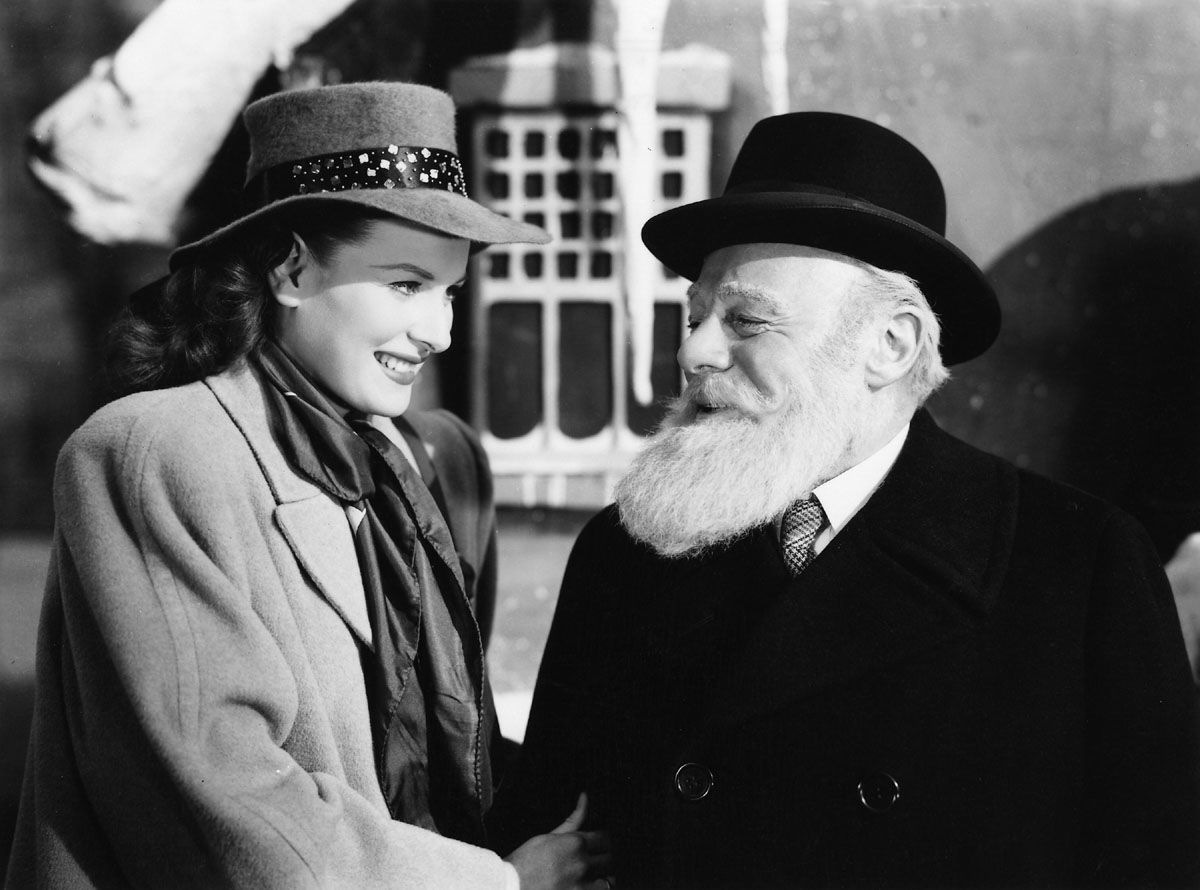 Now this is America. And as you know, here if something works once, that means it needs to be done over. And bigger. With more stuff. And preferably in color.
And that's what happened to "Miracle". Actually, it happened FIVE times; two one-hour television versions in the Fifties, a musical in the Sixties (but all sorts of awful musicals happened in the Sixties, so it wasn't exactly the worst of its type...), a TV movie in the Seventies, and, finally, a theatrical movie in the Nineties.
The 1994 movie version, for some reason, has been in heavy rotation on the usual calbe channel suspects lately; Lifetime, "Family", Hallmark. Its really kind of intriguing, in a sort of true-crime-story way, to see the difference between the America that had just emerged from the abyss of World War 2 and the one that was the Sole Superpower, the Indispensable Nation, the gigantic economic and political colossus then at the height of its power and wealth.
 The players are all there; Richard Attenborough as Kris, trying to look Gwennishly charming and succeeding in looking merely dyspeptic. Dylan McDermot replaces Payne, looking more intent but less decent. Elizabeth Perkins, whose ability to play vulnerably intelligent women I truly enjoy, does so here and deftly as always. Mara Wilson does a decent job as Susan, although she never manages Wood's luminosity or her skeptical intelligence (which is a problem, because the story calls for convincing the prenaturally adult Wood to feel and love childishly to be a Santaesque labor, whereas Wilson comes off as just a nice kiddo).
John Hughes directs.
That's not the problem.
The problem is that the story was perfectly suited for the sunny, lighthearted good sense of the Forties. The original never felt strained, never lectured, never brooded or pouted. It was a straightforward tale of whimsy, well-told, but with a good-humored wink towards the audience.
The Nineties version has none of this. It is uneven in tone, sometimes childishly callow, sometimes cynical, and adds a disturbingly strong, wildly out-of-place thread of religious piety to the plot, disturbing since the entire story is based on the central reality of that very Anti-Christ of American commercial Christmas, Santa Claus.
I should add that the religiousness comes across to me as rather mean-spirited, not presented as a sort of warm God-fuzzy but rather as a failure on the part of the irreligious. You first encounter it when Fred comes over to have Thanksgiving dinner with Susie and her mom. They don't say grace, you see, and Doris (inexplicably renamed "Dorie" in this one) is made to act embarassed and contrite about it. Because people who don't have God or religion can't really be good people, right?
The tone is very reminiscent of the sort of "Christmas Wars" then being fought at the time the remake was made, and the film shares something of the sour and accusatory tone of the time. Very unpleasant.
The injection of God and worship into the original cheerfully irreligious story is jarring in more ways than just the way it places God and Santa uneasily alongside each other. It rips the wonderful setpiece out of the climax of the story.
Instead of the endless chain of letter-carriers tromping into the courtroom with their bags and bags of Santa letters - proving that the U.S. Post Office believes Kris to be the "one and only" Santa - we have a very strained and badly skewed moment involving the little girl, a Christmas card with a dollar in it (WTF?) and the motto "In God We Trust" circled with hi-lighter.
 (Don't get it? Me, neither. The film has the trial judge go into some long-winded explanation about how the U.S. Department of Treasury can believe in God with no hard evidence so the people of New York can believe in Santa Claus in the same way (conveniently ignoring such precedent as Lynch v. Donnelly, 465 U.S. 668 (1984) in which the Supreme Court held that the motto has "lost through rote repetition any significant religious content" and called it mere "ceremonial deism"). Yeah, yeah, I don't buy it, either. It's crap, and badly written crap, at that).
 Not content with replacing the best scene in the flick with a pottage of claptrap, Hughes then proceeds to add one last bit of bizarre business. His Dorie and Fred get married (at Midnight Mass, no less, slamming your head against the Jesus is The Reason For The Season wall again in case you forgot the whole "In God We Trust" thing) and then go house-hunting.
 The house thing is right out of the 1947 original, where city-bound little Susan wanted the Forties American Dream House in the 'burbs for Christmas. In that version the house is the setup for the punchline (Kris really IS Santa, see..?) as well as the Fred-and-Doris kiss-and-let's-get-married-and-be-happy-families that makes the Happy Ending of the story. Fade to black.
In the Hughes version, same setup, except instead of just wanting the house for Christmas Susan had Three Wishes (John Hughes - Brilliantly Original Thinker, eh?); a dad, the house, and a baby brother. When they get to the house, Susan announces that she now has ALL her wishes. Fred and Dorie goggle at her, at each other, then down at Dorie's womb. Booiiiinnng! Santa is like Christmas' Fertility God, see? He puts babies in ladies' tummies!
WTF?
Anyway, I don't enjoy the Nineties version enough to sit all the way through it, but it keeps turning up like the mouse the cat keeps dragging inside no matter how often you toss it into the yard. So I've now seen almost all of it mow in bits and pieces.
And between the nonsensical alterations, the strident piety, and the overall dark and charmless tone, the newer version of "Miracle on 34th Street" just seems to me to say something very unkind about us Americans of 1994 and 2010. I know the flaws of the Forties, I know all about the flaws of the people who lived at that time; they were and are my parents.
But it just seems that the sort of people who made that movie were different people than the ones who made the last one, and that based on the difference between the films, the changes that occurred in the people weren't particularly good ones.
Saturday, October 23, 2010
Me Tondelayo
Caught the 1942 MGM chestnut "White Cargo" the other night.
Hard to try and discuss the thing, what between the bad acting, wooden directing, terrible script and, particularly, the amazingly out-front Forties racism and misogyny. All it lacked was some dancing pickaninnies and a comical John-Wayne-variety wifebeating. Seriously. It stunk just that bad.
The racism was so bad it wasn't even Forties-tolerable. The original New York Times reviewer called White Cargo "that antique lot of bunk which could, with the proper treatment, be made into screaming farce—you know, that lurid business about white men in darkest Africa going to pot from the heat, too much booze and the charms of a dusky native girl." But the "dusky native" girl" is, of course, the only reason to watch this dog anymore, since Hedwig Eva Maria Kiesler - better known as Hedy Lamarr - was a native of Austria and dusky by virtue of whatever Metro used as spray-tan in the war years (since the genuine spray-tan was needed to make GI boots or something...) but was certainly all girl, or woman, and slinks about the film in cocoa makeup and a sarong speaking a bizarre sort of pidgin. Although the film is set somewhere in British colonial Africa Hedy's character, "I am Tondelayo" is said to be Egyptian/Arab, probably to get around the Hays Office issue with portraying white-black sex on screen.
And thats "White Cargo" summed up, really. Sex. Forbidden, blacky-white sex. It's about the stalwart White Man's burden; the slinky, scheming Dark Woman, who wants only to mulct him for the benefits of his White Progress by enticing him with her irresistible dusky poozle. Of course, Whiteness triumphs in the end, as the scheming Hedy/Tondelayo is forced to drink the Vile Puggle she is using to poison her white husband and runs screaming off to, presumably, Do The Right Thing and die in lonely agony in the jungle.
Hedy is both wonderfully scenic and monumentally awful, though her thigh-slapping Tonedlayo Dance really has to be seen to be appreciated. It's hard to believe she can't act, as she did well in other pieces both before and after this, and it's difficult to guess whether it was the rotten script or the bad direction that makes her so bad, or whether she just really hated the film and the part. Certainly the reviewers did, but at least they got some vicious entertainment value from it. From the NYT, again;
The injustice hidden underneath all that makeup is that Hedy was, in her way, a really brilliant woman. Her adventures, beginning with her escape from Europe and a beast of a first husband, are as good as a storybook, and she seems to have been something of a minor genius with a knack for invention, developing an early version of radio frequency-hopping that eventually became the SINGCARS radios I used in the Army in the 1990s and Oughts.
I'm not kidding. Got it patented and everything. Smart woman..jpg) She was also a difficult person, too, apparently, with all sorts of personal and money problems. She was broke a lot later on, and was caught stealing several times. She sued a lot of people later in her life over use of her name and image; she never really managed to transfer her wartime-era glamor into a career in films that survived the Next Hot Girl and she seems to have become pretty damn bitter about it. She had a very up-and-down sort of life after the stardom years, and died in Florida ten years ago this January in relative obscurity.
She was also a difficult person, too, apparently, with all sorts of personal and money problems. She was broke a lot later on, and was caught stealing several times. She sued a lot of people later in her life over use of her name and image; she never really managed to transfer her wartime-era glamor into a career in films that survived the Next Hot Girl and she seems to have become pretty damn bitter about it. She had a very up-and-down sort of life after the stardom years, and died in Florida ten years ago this January in relative obscurity.
But she was riding the crest the year she made "White Cargo", and as bad as the film is it's hard to watch it, and her vamping sullenly in her ridiculous makeup and imagine the hard years to come. In the flickering monochrome darkness of my living room in Portland, 2010, it was still 1942, the war was waiting outside, and the gorgeous woman with the lissome figure was still smiling up succulently and husking "What Tondelayo want, Tondelayo get."

Hard to try and discuss the thing, what between the bad acting, wooden directing, terrible script and, particularly, the amazingly out-front Forties racism and misogyny. All it lacked was some dancing pickaninnies and a comical John-Wayne-variety wifebeating. Seriously. It stunk just that bad.
The racism was so bad it wasn't even Forties-tolerable. The original New York Times reviewer called White Cargo "that antique lot of bunk which could, with the proper treatment, be made into screaming farce—you know, that lurid business about white men in darkest Africa going to pot from the heat, too much booze and the charms of a dusky native girl."
 But the "dusky native" girl" is, of course, the only reason to watch this dog anymore, since Hedwig Eva Maria Kiesler - better known as Hedy Lamarr - was a native of Austria and dusky by virtue of whatever Metro used as spray-tan in the war years (since the genuine spray-tan was needed to make GI boots or something...) but was certainly all girl, or woman, and slinks about the film in cocoa makeup and a sarong speaking a bizarre sort of pidgin. Although the film is set somewhere in British colonial Africa Hedy's character, "I am Tondelayo" is said to be Egyptian/Arab, probably to get around the Hays Office issue with portraying white-black sex on screen.
And thats "White Cargo" summed up, really. Sex. Forbidden, blacky-white sex. It's about the stalwart White Man's burden; the slinky, scheming Dark Woman, who wants only to mulct him for the benefits of his White Progress by enticing him with her irresistible dusky poozle. Of course, Whiteness triumphs in the end, as the scheming Hedy/Tondelayo is forced to drink the Vile Puggle she is using to poison her white husband and runs screaming off to, presumably, Do The Right Thing and die in lonely agony in the jungle.
Hedy is both wonderfully scenic and monumentally awful, though her thigh-slapping Tonedlayo Dance really has to be seen to be appreciated. It's hard to believe she can't act, as she did well in other pieces both before and after this, and it's difficult to guess whether it was the rotten script or the bad direction that makes her so bad, or whether she just really hated the film and the part. Certainly the reviewers did, but at least they got some vicious entertainment value from it. From the NYT, again;
"...Metro has chosen to play it for Drachmae and implications of sex—or, at least, as much as the Hays office would let pass, which is mostly wiggles and leers. It has given Hedy Lamarr a mahogany finish, a limited vocabulary and a few dry goods and turned her loose to play Tondelayo with whatever else she happens to have. It has called upon Richard Carlson to be the sap who cracks up at this display, and it has set Walter Pidgeon, Frank Morgan and several other able actors to sweating and shouting the most abusive and ridiculous twaddle that has been heard in a long, long time.You write that today, Jackson, and you've got a hell of a lawsuit on your hands, but I have to agree - "White Cargo" sucked pipe.
As the gentlemen keep telling one another, the dry rot has set in—on the Capitol screen. Or is it the damp rot? We can't remember. But it is some kind of rot; that much is sure."
The injustice hidden underneath all that makeup is that Hedy was, in her way, a really brilliant woman. Her adventures, beginning with her escape from Europe and a beast of a first husband, are as good as a storybook, and she seems to have been something of a minor genius with a knack for invention, developing an early version of radio frequency-hopping that eventually became the SINGCARS radios I used in the Army in the 1990s and Oughts.
I'm not kidding. Got it patented and everything. Smart woman.
.jpg) She was also a difficult person, too, apparently, with all sorts of personal and money problems. She was broke a lot later on, and was caught stealing several times. She sued a lot of people later in her life over use of her name and image; she never really managed to transfer her wartime-era glamor into a career in films that survived the Next Hot Girl and she seems to have become pretty damn bitter about it. She had a very up-and-down sort of life after the stardom years, and died in Florida ten years ago this January in relative obscurity.
She was also a difficult person, too, apparently, with all sorts of personal and money problems. She was broke a lot later on, and was caught stealing several times. She sued a lot of people later in her life over use of her name and image; she never really managed to transfer her wartime-era glamor into a career in films that survived the Next Hot Girl and she seems to have become pretty damn bitter about it. She had a very up-and-down sort of life after the stardom years, and died in Florida ten years ago this January in relative obscurity.But she was riding the crest the year she made "White Cargo", and as bad as the film is it's hard to watch it, and her vamping sullenly in her ridiculous makeup and imagine the hard years to come. In the flickering monochrome darkness of my living room in Portland, 2010, it was still 1942, the war was waiting outside, and the gorgeous woman with the lissome figure was still smiling up succulently and husking "What Tondelayo want, Tondelayo get."
Subscribe to:
Posts (Atom)