Showing posts with label odd historical stuff.... Show all posts

Wednesday, April 25, 2012

Lead-pipe Cinch

Thinking about Latin lead me to Rome, and that, in turn, lead me to remembering this oddiment of historical trivia; did you know that most Roman public water systems ran through lead pipes?
Seriously. In fact, the Romans used a LOT of lead in their daily lives; pipes, roof tiles, glazes, stoppers on wine jars...you name it, the Romans could and would make it out of lead. In particular it was used in the white cosmetic paint used by well-to-do women (and not just Roman women - the whiteface Elizabeth Tudor is often shown wearing later in life had a hell of a lot of lead in it...)

You can sort of see why they used it; it's a fairly common metal. It's really easy to work. You can use it in paints, glazes, or cast objects from it. It doesn't rust or otherwise deteriorate. there's really only one significant problem with it;

If you ingest it, it's a poison.

In fact, some historians have suggested that as such it may have played a role in the problems in the later Roman period:
"S. Columba Gilfillan proposed a theory for Roman decay in 1965 that involved "poisons esteemed as delicious by the ancient well-to-do." Spoilage was a problem in ancient Rome, and vintners discovered that wine tasted better and lasted longer if it was mixed with a concentrated grape syrup called sapa. The best sapa was boiled in lead pots, allowing lead to leach into the syrup. When sapa was mixed with wine, it sweetened it and also poisoned the microorganisms that cause fermentation and souring. Sapa was also used in fruit and honey drinks, and as a food preservative.

Josef Eisinger estimated a Roman consuming a liter of wine a day would ingest about 20 mg of lead per day, which he said was more than enough to produce chronic lead poisoning.

A cultural shift at the height of the Roman Empire made it socially acceptable for wives to drink wine, to which Gilfillan attributed a declining birth rate and a low rate of surviving children among the wealthy. Today, the reproductive effects of lead are well established, as are the effects on childhood development and learning disabilities.

Gilfillan hypothesized that the diet of the poor was not so badly poisoned as that of the rich. Although they drank the same water, they lacked the luxuries of cosmetics, lead paint, wine, fruit and honey drinks, or preserved foods."
It's difficult to say whether all this lead was a genuine problem; there were enough other problems to make things interesting long before the lead got in there - untreatable epidemic disease, widespread poverty and slavery, poor hygiene, bad diet.

But, still...interesting tidbit of history.
Thirsty?

Monday, February 13, 2012

Luftschiffe

One thing that one of the regular commentors here noticed that I hadn't - at least consciously - was the regular appearance of the image of a rigid airship, a zeppelin, in the cartoon doodlings from the past week.He asked if I'd been reading steampunk fiction lately, and while I enjoy the genre the answer is no; I've always been a sort of zeppelin crank.They just seem sort of dangerously cool to me, and I love the idea of this massive thing floating along nearly silently, like a cloud only with several tons of bombs inside, over an enemy landscape as a sort of aerial assassin. Scary cool, if you will.Mind you, if I was on the ground the scary would have it all over the cool.

And even in the air - the rigid airships seem to have been fiendishly dangerous for their crew and passengers. Certainly the German zeps got hammered by constantly improving antiaircraft and fighter defenses. The statistics tell the story; 53 destroyed and 24 damaged to the point of being non-mission capable out of an total of 115 airships. Crew loss rate of 40%. Cost about five times the total damage inflicted.Still. Call the zeppelins a personal quirk, an indulgence, one of my hidden passions, an odd devotion to a vestigial past.Airships are still just freaking cool.

Anybody else out there have one of these odd, trivial passions?

Wednesday, May 25, 2011

Love in the time of cholera

I've been reading Doris Goodwin's "Team of Rivals" off and on this spring. It's an interesting story in itself - the history of how Abraham Lincoln the politician first finessed his political foes into the Republican nomination and then coopted them into becoming members of his first Cabinet - and the telling is as worthy as the material. Goodwin has a flair for popular history and writes well, using small touches to illuminate a landscape as vanished as the Pliocene to most of us.And that's an important part of any history. Because it can be difficult, especially when the time in consideration is at some remove, to get a sense of the people of the time as...people.

The temptation is to see them either as moderns dressed in period costume, or as some sort of freakish antique, acting and thinking in ways impossible to any "real person" the reader knows.

And in understanding how they acted, and why, how they thought, how they saw the world around them, is crucial. A historian writing for the general public has to be capable, in a handful of sentences or a paragraph or two, present the past life both in itself and in its context so that the modern reader can grasp both the qualities of the person discussed and their standing with the person's times. Was she an especially bold woman, an iconoclast, or was she more typical of her contemporaries? Were his acts, or thoughts, likely to be the product of his surroundings or owe more to the inner daemon of the man?Obviously most histories are written about dramatic times and "great" events - few histories are written about the daily lives of vanished people in humdrum times. So the questions become; how did this or that person fit into the tenor of his or her time? When they acted, did they follow opinion or lead it? Did they act against the grain of their own era, or in conformance with its strictures? Did what they did tell us something useful about people, and events, and societies, that we can use in our own lives?

Goodwin's account is no different, and thus she spends some time early on establishing the characters of the central figures; Lincoln himself, obviously, his principal "rivals" (Ed Stanton, Will Seward, Sal Chase, and Ned Bates) and their various parents, wives, sons and daughters, as well as their political cronies and associates.It's a good tale, and it doesn't hurt that pretty much all of the main characters are fairly colorful. Lincoln is an ediface, a man recognized even in his time as a singularity. Stanton, Seward, and Chase are all men with immense egos and strong wills or they wouldn't have gotten where they did.

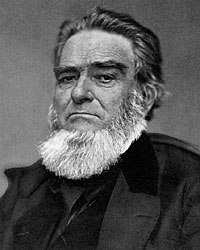
The one who's sort of the odd man out is Bates.Here he is, a Victorian patriarch and stern paterfamilias there ever was one. You can't picture even his friends calling him "Ed" or "Eddie" or "Ned". He's a "Edward" if ever I saw one.

But that's the interesting thing. He wasn't. Ed Bates was a man passionately in love with his wife, and desperately in need of his family. Goodwin keeps on about this; Bates married Julia Coulter in 1823 and spent the rest of his life falling in love with her. He kept his hand in politics because that what what a man of his class did. But he was miserable when he had to leave his home for D.C., and his letters to Julia are full of longing and his own loneliness and melancholy apart from her.

The Bates' marriage seems to have been more than just a spiritual one; Julia bore sixteen children (sixteen! My mind reels (and my pelvis sches) at the thought...) over the next thirty years. Here she is as a sturdy matron in her forties, but her husband seems to have been just as gaga over her as the day she put on - and took off - her brideclothes.

One of the most difficult parts of human life to transport over the distance of time is emotions and the way we express them. Certainly some elements, the biological ones, are fairly immutable; so a man or woman in Celtic times, or in ancient China, or in modern Peru, must certainly feel physical lust. That desire is a built-in designed to keep little humans coming along, and certainly the Roman man looking at a comely puella, or a Victorian woman glancing at a handsome lad must have felt a touch or more of the same visceral stirrings down in the libidinous regions that you or I would.

But the difference is in the detail. What sort of thing would a Roman find intriguing...as opposed to titillating, or mysterious, salacious, or challenging? We've read about how the mere glimpse of a shapely ankle could send a straitlaced Victorian man into a paroxysm of desire. But could it, really? Does having your inamorata always covered in draperies make the ankle an erogenous zone...unless it would be for you, anyway?

Because, apes that we are, we're a very visual species. We like to look, and where people are concerned, we like to look at the people we're attracted to for the things that attract us. Being not just apes but thinking apes (well, at times and of a sort...) there's more to attraction than JUST what we see. But we still place a great deal of importance in the physical aspects we consider pleasant.

Fortunately for the species, those aspects are pretty flexible. Whether Victorian or post-modern, some of us delight in the familiar, while others are drawn to the "different". Some find certain traits desirable, others the opposite, so while one woman finds a small, neat, blackavised man to her liking another gets a frisson of pleasure looking at his lanky, sun-fair friend.

But...here again, as people's manners and mores have changed through time, so have their standards of beauty. The difficulty of trying to understand someone like Ed Bates or Julia Coulter is trying to get a clue for how they thought about each other. What was "love" to them? How did they say it? Or did they? Certainly the Victorian standards of public behavior, so much more elaborate than ours today, would imply a great disparity in the intimacy a man and woman could show in public as opposed to within the privacy of the marriage-bed. But to what degree? Looking at the man, could Julia have been calling him "Mister Bates" even in their most unguarded moments?

And what of him? Could the dignity of a Victorian gentleman relent to the pure sensual enjoyment of his beloved wife; of an endless moment with his face buried in the scented darkness of her hair, every nerve-ending shirring beneath its satiny heaviness, hearing nothing but the sound of her breathing, touching his brow to the dear curvature of her head, the one he cherished because it held the vital spark, the life and thoughts, the whole essence of the one so dear to him in that fragile orb.

Well, as I read through the section about the Bates' marriage I came across something very like this. Edward was in D.C. when his first daughter Nancy was born. His letter conveys his longing and regret at putting his office before his child. And he asks Julia to tell him all the details of "how she is - what she is - what she is like...whether she has black eyes or gray - a long nose or a pug..."

And then he writes an odd little thing. "...and above all..." he implores, "..whether she has a pretty foot." for unless she has a foot as pretty as her mother's she "could never make a fine woman."

And it was this bit of parental and husbandly foolishness that caught me. Because I am a bit of a fool for a woman's hands, and her feet. I've always enjoyed holding hands, feeling the intricate textures of bone and sinew that can hold such character.

A woman's hands (or a man's, for that matter) can speak as or more eloquently than her face, her body, or even her words, of the nature and quality of her. Well-worn or pampered, slender or square, smooth or muscular...it takes a lifetime of living within her hands, of walking the roads her feet take her, to make them, and her, the woman she is. If you cherish the woman, than every line and muscle that makes her her, becomes dear in ways that are hard to express.

Or, hell, maybe people like Ned Bates and I are just queer for feet...

But whatever the reason, that little paragraph helped me see them not as stiff pictures in a book but people, people-people. I could vividly picture this long-dead couple, these vanished people preserved in silver salts and black back in the days of their happiness, perhaps lying lazily abed with her "pretty feet" in his lap as he gently rubs them after a long day. Enjoying the feeling, enjoying the moment, just enjoying each other.Silly, isn't it? And yet, it was that little detail, as one who has often admired my own wife's neat and strong feet as I worked the lotion into her sole and heel-ball and soothed out the aches and stiffnesses of a day's work, that connected these strangers to me, that made me feel like I understood him, and her, just a bit, and through them a bit more of the time and the tides of the world that had borne them up, he and his beloved, on the long swells of a dim-lit sea an ocean of time and a world of lives ago.

And if that's not how a good history works, I can't think of a better.Let me leave you with the words of the Victorian lover himself;

"Oh! How I long to press you to my bosom, if only for a moment. Sometimes, I almost realize the vision - I see you with such vivd and impassioned precision, that the very form developing is in my eye. O, that I could kiss the tear from that cheek whose cheerful brightness is my sunshine."

Sunday, April 24, 2011

Losing My Religion

So Friday I posted about my disgust and despair at the condition of my country's politics.

Pat, like a Terminator in a James Cameron film, came Dave Brooks to drive the last nail into the lid of that political coffin with "Creed or Chaos" in Thursday's New York Time.

Now like you, I usually ignore Bobo. He's an idiot. But...here's the thing.

As an idiot, he usually represents the mainstream Republican sort of idiot that has run the party since Reagan clubbed the last of the Rockefeller and Eisenhower faction like a blubber-chewing Inuit with adorable baby harp seals. Bobo's writings (and by "writings" I mean "nearly incomprehensible errata scrawled on the padded walls by the gibbering inmate using his big toe and a slurry of drool and his own feces") are a way to glimpse, in a sort of lifting-the-rock-to-observe-the-writhing-vermin-beneath way, what goes on inside the brainpan of a typical country club Republican.

I should be specific; this does NOT include the sort of thing that occurs inside the occipital lobes of the Palinite/Teatard Wing of the GOP. God knows what the hell those people think about; probably gypsy knives and gypsy thighs that pound and pound and pound and African appendages that almost touch the ground and little boys playing baseball in the rain. But, whatever. Bobo does nothing to enlighten you about whatever THEY think.

But for the Kiwanis-Chamber-of-Commerce-former-Quayle-supporter sort of Republican, Bobo's your man. He stands athwart the GOP like a sort of teeny tiny Colossus, mouthing the sorts of things that make the Republicans feel warm and snuggly as they enter within.

So his Thursday column was a real revelation for me, because in it the spokesmodel for the two-SUV family advocates that African - and by inference, U.S. - Christians should be more like Torquemada and less like Pastor Niemoller.

"Many Americans" he says "have always admired the style of belief that is spiritual but not doctrinal, pluralistic and not exclusive, which offers tools for serving the greater good but is not marred by intolerant theological judgments."

But this is so, so wrong, explains Bobo.

Why? Because "The religions that grow, succor and motivate people to perform heroic acts of service are usually theologically rigorous, arduous in practice and definite in their convictions about what is True and False."

Now based on human history you might be forgiven for thinking that religions that are "theologically rigorous" (meaning: intolerant of dissent and punitive to religious deviance), "arduous in practice" (meaning: insisting on complete obedience regardless of cost), and "definite...about what is True and False" (meaning: convinced that any variation from orthodoxy is False, unrighteous, and, presumably, unGodly) tend to be by nature militant, divisive, intolerant, and often dangerous to anyone and anything not beloved of their God and his tenets.

You might be forgiven for thinking that such religions are prone to outbreaks of violent persecution and religious war when they collide with people or cultures they anathematize.

You might be forgiven for thinking that such religions tend to make people smug, self-satisfied, rigid, intolerant, slothful entitled pricks.

But Bobo would not forgive you any such thing.

Because Bobo thinks - meaning that your average country club Republican, your average Republican, period, thinks - that people qua people are stupid, feckless, lazy scumbags.
"No matter how special some individuals may think they are," says Bobo, "they don’t have the ability to understand the world on their own, establish rules of good conduct on their own, impose the highest standards of conduct on their own, or avoid the temptations of laziness on their own."
Think about that for a moment.

......

Bobo goes on to insist the following:

1. Rigorous theology provides believers with a map of reality.

2. Rigorous theology allows believers to examine the world intellectually as well as emotionally.

3. Rigorous theology helps people avoid mindless conformity.

4. Rigorous theology delves into mysteries in ways that are beyond most of us.

5. Rigorous codes of conduct allow people to build their character.

You got that? People whose religion demands that they accept every jot and tittle of the Holy Word (no shrimp or owl for dinner, no sex during menstruation, stuff like accepting that a consecrated celebate in a three-ringed crown is channeling the Great Spirit verbatim) are the only ones with a Michelin Guide to reality, the only ones with real intellectual acuity, the only ones with genuine originality, the only ones with the keys to the Great Mysteries.

Oh, and the only ones capable of avoiding sex with vegetables and stealing pocket change.

Okay.

I'm perfectly willing to grant you that religion, whether "theologically rigorous" or otherwise, has been the foundation of some of humanity's most incredible achievements. Faith has motivate humans to raise cathedrals to the sky, care for the sick and dying, help the poor, found cities and even nations. Religions touch something very vital in many, perhaps even most, people.

But at the same time, religion has been behind some of history's great horrors. Religions have butchered children for their "sins". Religions have sent entire populations lurching into others' lands; murdering, raping, looting in the belief that the "others" were beneath the consideration of God's love - indeed, that God demanded the others' lives as punishment for their unbelief in the invaders' God or gods.

Religions have also helped people justify those horrors, often by their very nature, in that something that helps you believe the improbable often helps you embrace the unthinkable. Bobo cites Dorothy Sayers (who was a delightful novelist and decent scholar but whose door wasn't exactly hanging on all its hinges, theologically speaking) saying that
"...Christianity’s advantage is that it gives value to evil and suffering. Christianity asserts that “perfection is attained through the active and positive effort to wrench real good out of a real evil.” This is a complicated thought most of us could not come up with (let alone unpack) outside of a rigorous theological tradition."
No. This isn't a complicated thought most of us could not come up with (let alone unpack) outside of a rigorous theological tradition. It is fucking nonsense.

Evil is evil, suffering is suffering. Fighting evil (assuming that it IS evil and not just something "abhorrent before My God" like boys having sex with other boys or women voting) is admirable, enduring suffering bravely is honorable. But neither of those "give value" to evil and suffering.

Evil and suffering are plagues on humanity, full stop, and anyone who believes that they are valuable because they allow Christians to achieve perfection through fighting them are as fucking nuts and stupid as a bag of hammers.

So, resolved; anyone who tortures, or butchers, a tiny baby is a vile criminal bag of fuck. Unless, says Dotty and Bobo, it allows a Christian "to wrench real good out of a real evil."

What.

The.

Fuck?

It is just this sort of tortured logic that allowed Crusaders (or their Islamic, Hindu, and Buddhist equivalents) to believe that their evil had value, that by slaughtering infidel women and children got them closer to Paradise.

This is madness. THIS is evil.

If this were all Bobo brought with him I could simply walk away with a shrug. Theocrats are a nickel a gross; they have arisen throughout history, usually from a heap of human bodies, and have largely been tossed aside when the survivors realize what an intolerable pain in the ass being ruled by someone who insists that all his or her opinions are crafted in God's toy shop. Theocracy is probably the worst single form of human governance and has been proved as such again and again by practical example.

But remember - this isn't just Bobo.

This is the mainstream wing of the GOP that Bobo represents. It is this group that honestly believes that their fellow Americans are unable to think, plan, or control where they put their penises or vaginae (vaginas?) without Baby Jesus there to point out Tab A and Slot B and what doesn't go where. This group seems to think that what the U.S. needs is more "theologically rigorous" religion and less "...(v)ague, uplifting, nondoctrinal religiosity..."

The real genius of the Framers was not to toss religion out of U.S. public life. They knew their country and knew their fellow citizens. They knew that the religion would get there one way or another. No, their genius was to ensure that when it did arrive a the public square it would be gutted of its "theological rigor". That it could not test Americans on their knowledge of the doctrine of transubstantiation, of the traditions of a seder, of the Five Pillars as a price of citizenship, couldn't demand fealty to any theology as a cost of entry into public business, or privilege one over another, either in public or private.

Regardless of how vile this belief is to that one, regardless of how many lives of one faith the other has taken.

This country is founded on the notion that you in the name of your religion WILL NOT be allowed to take public action against me for mine. And if you take private action that traduces my public rights you will be prosecuted for it.

This has gone a long, long way to producing the secular character of U.S. public life - despite the very public presence of religion, a presence nearly absent in Europe, a continent much more familiar with the evils of "theologically rigorous" religions and their public feuds - and the large number of U.S. believers who leave the outward trappings of their faiths in church, synagogue, and mosque.

But Bobo, and his GOP counterparts, seem to think this is a mistake. They think all this warm fuzzy ecumenism is a dodge, a cunning scheme to defile our vital bodily fluids. And what should we do to avoid this weakening, this flaccidity, this impotence of the American soul?

Well, "changes in behavior change the mind," Bobo reminds us, "...so small acts of ritual reinforce networks in the brain. A Mormon denying herself coffee may seem like a silly thing, but regular acts of discipline can lay the foundation for extraordinary acts of self-control when it counts the most."

And y'know what? If you started on young Americans with those "regular acts of (theologic) discipline" early enough you could probably lay the foundation for a cruel unflinching youth, a youth as hard as steel.

I wonder.

What could you do with people like that..?

.......

Note: On Mormonism

I observe that Bobo's observations were made posteriori to viewing something called the "Book of Mormon", a play by the guys who do "South Park".

Whilst I tend to be fairly tolerant of other people's personal beliefs if you wanted a religion to mock Mormonism is one of the fattest slow targets outside of genuinely fucking out-there religious goofologies of the Scientology breed.

I mean, read the Joesph Smith story. Guy is a "gold witcher" in Palmyra, NY, back in the 1820s, claiming that he can find gold with "magic stones". He claims that in 1823 an angel tells him where to find two golden plates written by Ether, Mormon, Lehi and Nephi, who are Native Americans circa 1AD, a brass plate with Hebrew scripture quotations and genealogies written by one Laban, oh, yeah, and "Urim and Thummim," magical translating stones.

Magical translating stones.

Okay. Now he doesn't head out, snatch this boodle and run, mind you. Nope. Instead, in 1825, he and his dad head to Pennsylvania to look for buried treasure at three bucks a day. Nothing turns up and Smith offers the suggestion that the treasure had sunk deeper due to...to...ummm...err...enchantment! That's it; enchantment! Seriously! Enchantment!

Yeah, okay Joe, sure.

He loses the job but finds a wife, Emma, the local schoolmarm. They elope in New York in 1827. Which is, you'll remember, when Joe trudges back to Palmyra to get all that golden loot and the Indian-Jesus stuff, remember?

So between 1827 and 1829 Joe Smith "dictates" the "translation" of these supposed golden plates (which no one but he has seen, remember) to his new wife and a couple of pals. The entire business is odd; sometimes he's hidden behind a screen, when he's not the tablets aren't in view. He puts the "magical stones" in his hat...and puts his hat over his face.

He finishes the "Book of Lehi", lends it to his pal Marty Harris, who takes it home and "loses" it (supposedly Lucy, who hated Smith and thought he was a fraud, tossed it).

That sucked, and Smith now says that God has taken away the "special stones" because Joe's buddies stepped on their poncho, and he starts on the "Book of Nephi" which, he says, tells the same story as Lehi only, you know, sort of, different.

Anyway. The Book of Nephi, if you've ever bothered to skim it, reads like one of those Fifties sword-and-sandal movies, with lots of thud and blunder, prophets, visions, a "ball of curious workmanship", and how Jews became the native Americans.

Really, no shit.

If you put the whole thing in a movie and got McG to direct it nobody would believe a word of it, although I would pay good money to see Adam Sandler play Smith, the old Sandler back when he was funny.

Tina Fey could play Lucy.

Either way, it seems to have become a religion because people who want to believe stuff will believe it regardless of how goofy it's backstory is. And you can say this for Mormonism as you pass up your morning coffee.

It sure as hell is "theologically rigorous."

Thursday, February 10, 2011

The Sex Goddess' Thumb

While researching the preceding post (on the Battle of Chipyong-ni, 1951), I spent some time scrounging the Internets for illustrations. While doing that I found this, a snapshot taken of the three-day USO tour Marilyn Monroe did in February, 1954.As I was looking over the picture (and, quite unexpectedly, oogling La Monroe in a sadly goatish fashion of a man of my age and weight) I noticed an odd little thing.

Her right thumb is bandaged.

Enlarge the picture and look for it. See it?

I don't know why that struck me as so odd and interesting. Possibly because I'm accustomed to the current seamless ability of the entertainment industry to make boo-boos like that disappear. Have you ever seen a current star, or even a starlet, with band-aids, bruises, bad hair (seen outside of the paparazzi sections of the checkstand rags, I mean)?

I was fascinated. What had happened? Fight with new hubby Joltin' Joe? Slipped on a microphone cable? So I went back to the 'Net, and...

Turns out that the Sex Goddess of the Fifties was cutting a cake for some soldiers when the knife slipped and she cut herself, quite badly, by the look of it.But no matter - the show went on and, apparently, went like free beer. Both the troopers, and the star, loved each other. It's kind of a nice story.

And Heaven knows if anyone needed a nice story it was Norma Jean, whose short life contains entirely too much unhappy drama.Nothing deeper than that; just a tiny bit of trivia for a Thursday evening.