I've been reading Doris Goodwin's "Team of Rivals" off and on this spring. It's an interesting story in itself - the history of how Abraham Lincoln the politician first finessed his political foes into the Republican nomination and then coopted them into becoming members of his first Cabinet - and the telling is as worthy as the material. Goodwin has a flair for popular history and writes well, using small touches to illuminate a landscape as vanished as the Pliocene to most of us.

And that's an important part of any history. Because it can be difficult, especially when the time in consideration is at some remove, to get a sense of the people of the time as...people.
The temptation is to see them either as moderns dressed in period costume, or as some sort of freakish antique, acting and thinking in ways impossible to any "real person" the reader knows.
And in understanding how they acted, and why, how they thought, how they saw the world around them, is crucial. A historian writing for the general public has to be capable, in a handful of sentences or a paragraph or two, present the past life both in itself and in its context so that the modern reader can grasp both the qualities of the person discussed and their standing with the person's times. Was she an especially bold woman, an iconoclast, or was she more typical of her contemporaries? Were his acts, or thoughts, likely to be the product of his surroundings or owe more to the inner daemon of the man?

Obviously most histories are written about dramatic times and "great" events - few histories are written about the daily lives of vanished people in humdrum times. So the questions become; how did this or that person fit into the tenor of his or her time? When they acted, did they follow opinion or lead it? Did they act against the grain of their own era, or in conformance with its strictures? Did what they did tell us something useful about people, and events, and societies, that we can use in our own lives?
Goodwin's account is no different, and thus she spends some time early on establishing the characters of the central figures; Lincoln himself, obviously, his principal "rivals" (Ed Stanton, Will Seward, Sal Chase, and Ned Bates) and their various parents, wives, sons and daughters, as well as their political cronies and associates.

It's a good tale, and it doesn't hurt that pretty much all of the main characters are fairly colorful. Lincoln is an ediface, a man recognized even in his time as a singularity. Stanton, Seward, and Chase are all men with immense egos and strong wills or they wouldn't have gotten where they did.
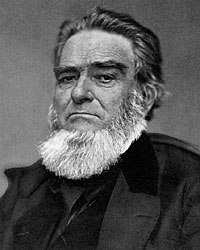
The one who's sort of the odd man out is Bates.

Here he is, a Victorian patriarch and stern
paterfamilias there ever was one. You can't picture even his friends calling him "Ed" or "Eddie" or "Ned". He's a "Edward" if ever I saw one.
But that's the interesting thing. He
wasn't. Ed Bates was a man passionately in love with his wife, and desperately in need of his family. Goodwin keeps on about this; Bates married Julia Coulter in 1823 and spent the rest of his life falling in love with her. He kept his hand in politics because that what what a man of his class did. But he was miserable when he had to leave his home for D.C., and his letters to Julia are full of longing and his own loneliness and melancholy apart from her.
The Bates' marriage seems to have been more than just a spiritual one; Julia bore sixteen children (sixteen! My mind reels (and my pelvis sches) at the thought...) over the next thirty years. Here she is as a sturdy matron in her forties, but her husband seems to have been just as gaga over her as the day she put on - and took off - her brideclothes.

One of the most difficult parts of human life to transport over the distance of time is emotions and the way we express them. Certainly some elements, the biological ones, are fairly immutable; so a man or woman in Celtic times, or in ancient China, or in modern Peru, must certainly feel physical lust. That desire is a built-in designed to keep little humans coming along, and certainly the Roman man looking at a comely
puella, or a Victorian woman glancing at a handsome lad must have felt a touch or more of the same visceral stirrings down in the libidinous regions that you or I would.
But the difference is in the detail. What sort of thing would a Roman find intriguing...as opposed to titillating, or mysterious, salacious, or challenging? We've read about how the mere glimpse of a shapely ankle could send a straitlaced Victorian man into a paroxysm of desire. But could it, really? Does having your inamorata always covered in draperies make the ankle an erogenous zone...unless it would be for you, anyway?

Because, apes that we are, we're a very visual species. We like to look, and where people are concerned, we like to look at the people we're attracted to for the things that attract us. Being not just apes but thinking apes (well, at times and of a sort...) there's more to attraction than JUST what we see. But we still place a great deal of importance in the physical aspects we consider pleasant.
Fortunately for the species, those aspects are pretty flexible. Whether Victorian or post-modern, some of us delight in the familiar, while others are drawn to the "different". Some find certain traits desirable, others the opposite, so while one woman finds a small, neat, blackavised man to her liking another gets a
frisson of pleasure looking at his lanky, sun-fair friend.

But...here again, as people's manners and mores have changed through time, so have their standards of beauty. The difficulty of trying to understand someone like Ed Bates or Julia Coulter is trying to get a clue for how they thought about each other. What was "love" to them? How did they say it? Or did they? Certainly the Victorian standards of public behavior, so much more elaborate than ours today, would imply a great disparity in the intimacy a man and woman could show in public as opposed to within the privacy of the marriage-bed. But to what degree? Looking at the man, could Julia have been calling him "Mister Bates" even in their most unguarded moments?

And what of him? Could the dignity of a Victorian gentleman relent to the pure sensual enjoyment of his beloved wife; of an endless moment with his face buried in the scented darkness of her hair, every nerve-ending shirring beneath its satiny heaviness, hearing nothing but the sound of her breathing, touching his brow to the dear curvature of her head, the one he cherished because it held the vital spark, the life and thoughts, the whole essence of the one so dear to him in that fragile orb.
Well, as I read through the section about the Bates' marriage I came across something very like this. Edward was in D.C. when his first daughter Nancy was born. His letter conveys his longing and regret at putting his office before his child. And he asks Julia to tell him all the details of "
how she is -
what she is - what she is
like...whether she has black eyes or gray - a long nose or a pug..."
And then he writes an odd little thing. "...and above all..." he implores, "..whether she has a
pretty foot." for unless she has a foot as pretty as her mother's she "could never make a fine woman."
And it was this bit of parental and husbandly foolishness that caught me. Because I am a bit of a fool for a woman's hands, and her feet. I've always enjoyed holding hands, feeling the intricate textures of bone and sinew that can hold such character.

A woman's hands (or a man's, for that matter) can speak as or more eloquently than her face, her body, or even her words, of the nature and quality of her. Well-worn or pampered, slender or square, smooth or muscular...it takes a lifetime of living within her hands, of walking the roads her feet take her, to make them, and her, the woman she is. If you cherish the woman, than every line and muscle that makes her her, becomes dear in ways that are hard to express.
Or, hell, maybe people like Ned Bates and I are just queer for feet...
But whatever the reason, that little paragraph helped me see them not as stiff pictures in a book but people, people-people. I could vividly picture this long-dead couple, these vanished people preserved in silver salts and black back in the days of their happiness, perhaps lying lazily abed with her "pretty feet" in his lap as he gently rubs them after a long day. Enjoying the feeling, enjoying the moment, just enjoying each other.

Silly, isn't it? And yet, it was that little detail, as one who has often admired my own wife's neat and strong feet as I worked the lotion into her sole and heel-ball and soothed out the aches and stiffnesses of a day's work, that connected these strangers to me, that made me feel like I understood him, and her, just a bit, and through them a bit more of the time and the tides of the world that had borne them up, he and his beloved, on the long swells of a dim-lit sea an ocean of time and a world of lives ago.
And if that's not how a good history works, I can't think of a better.

Let me leave you with the words of the Victorian lover himself;
"Oh! How I long to press you to my bosom, if only for a moment. Sometimes, I almost realize the vision - I see you with such vivd and impassioned precision, that the very form developing is in my eye. O, that I could kiss the tear from that cheek whose cheerful brightness is my sunshine."
 From this year's "Bad Sex Award" winner.
 And that's an important part of any history. Because it can be difficult, especially when the time in consideration is at some remove, to get a sense of the people of the time as...people.
 Obviously most histories are written about dramatic times and "great" events - few histories are written about the daily lives of vanished people in humdrum times. So the questions become; how did this or that person fit into the tenor of his or her time? When they acted, did they follow opinion or lead it? Did they act against the grain of their own era, or in conformance with its strictures? Did what they did tell us something useful about people, and events, and societies, that we can use in our own lives?
 It's a good tale, and it doesn't hurt that pretty much all of the main characters are fairly colorful. Lincoln is an ediface, a man recognized even in his time as a singularity. Stanton, Seward, and Chase are all men with immense egos and strong wills or they wouldn't have gotten where they did.
 Here he is, a Victorian patriarch and stern paterfamilias there ever was one. You can't picture even his friends calling him "Ed" or "Eddie" or "Ned". He's a "Edward" if ever I saw one.



 Silly, isn't it? And yet, it was that little detail, as one who has often admired my own wife's neat and strong feet as I worked the lotion into her sole and heel-ball and soothed out the aches and stiffnesses of a day's work, that connected these strangers to me, that made me feel like I understood him, and her, just a bit, and through them a bit more of the time and the tides of the world that had borne them up, he and his beloved, on the long swells of a dim-lit sea an ocean of time and a world of lives ago.
 Let me leave you with the words of the Victorian lover himself;
  Generally I like to think that my selection of "friends" helps me avoid the "I'm picking out my toe jam! :-b" sorts of status updates; luckily I'm not bombarded with much of that sort of brain-destroying crap.
 Mostly the site does what it is supposed to do and provides me a sort of party line to check in with friends and chat about this and that. For all the handwringing about how the Evil Twitter, Facebook, and whatever other electronic media bete noir de jour are destroying civil society by substituting for "real human interaction", when you think about it these things are just replicating the slower means of distant communication humans have used since the beginning of literacy.
 This has become a very roundabout introduction to a topic that emerged on Facebook the past week. Specifically, a friend of mine linked to this article in the New York Times discussing the falling out between the Roman Catholic bishop of Phoenix, Arizona, and a local formerly Catholic hospital.
 And the more I got to thinking about it, the more I found that I tend to believe in what I first said; that the bishop's job, if he were to be any sort of bishop and not a windsock for popular opinion, was to insist that the mother, as a Catholic or at least as the patient of a Catholic hospital, give her life for the life of her child in the same sense that a bishop would expect his priests to give their lives, if they had to, to ensure the lives, or the spiritual salvation, of those who depend on them.

