I hate to say this, but one thing that Facebook often lends itself to is a nattering lack of reflection.
I say this in a tone of rueful acceptance, mind you, not surprise or anguish.
It's a fucking "social network", after all.

Generally I like to think that my selection of "friends" helps me avoid the
"I'm picking out my toe jam! :-b" sorts of status updates; luckily I'm not bombarded with much of that sort of brain-destroying crap.

Mostly the site does what it is supposed to do and provides me a sort of party line to check in with friends and chat about this and that. For all the handwringing about how the Evil Twitter, Facebook, and whatever other electronic media
bete noir de jour are destroying civil society by substituting for "real human interaction", when you think about it these things are just replicating the slower means of distant communication humans have used since the beginning of literacy.

What is a "tweet" but a little postcard? What is a Facebook post but a short letter, a digital telegram, a typed-out phone call?
"Having wonderful time, caught fish, weather fine. Come soon, Woosie." I don't see how this happening in realtime, over a fiber cable, somehow makes the process dangerously antisocial. We've always enjoyed our long-distance relationships. Entire books have been published containing the epistolary friendships of pre-electronic times, when living a couple of tens of miles apart meant seeing each other once a year or so. People have always had ways of staying in touch with distant friends and lovers; these electronic means are just an adaptation of a very old gimmick, a quicker version of sending a house slave with a clay tablet to your brother and sister-in-law in Sumer.
But (and you knew there would be a but, didn't you?) to go with the advantages in celerity there is the disadvantage of brevity. If brevity is the soul of wit, it is the mother of inattention. A discussion limited to 420 characters isn't really much of a "discussion", and the one thing I find unlikeable about Facebook - I am not "on" Twitter and have no interest in doing so, since a tweet is even briefer than a Facebook post less informative, and thus more conducive to the ignorant-shouting sort of "communication" than Facebook - is that much conversation is necessarily brief and one-sided. A letter allows time and space for thought, and if two paragraphs are needed instead of one to dissect the issue they are there for the taking. The only limit is the paper and the patience of the writer, and reader.
Which may be the very heart of the matter. We as a culture are increasingly impatient; the notion of simply sitting and reading a letter - or a novel, or a long blog post - is becoming both difficult and challenging. Difficult because many of us are so busy, our days full of cascades of essential ephemera demanding our attention; challenging because our preferred style of prose is often simple and poorly suited to complex thought. While the text we read on paper or off the screen may be prolix the arguments are often crude, the exposition simplistic, and the argumentation circular or absent. So the quick declaratory statements of Facebook make us easier. We needn't marshal our overtasked intellectual reserve; the thinking is done for us.

This has become a very roundabout introduction to a topic that emerged on Facebook the past week. Specifically, a friend of mine linked to
this article in the New York Times discussing the falling out between the Roman Catholic bishop of Phoenix, Arizona, and a local formerly Catholic hospital.
It seems that the hospital in question performed an abortion on a woman who was in danger of injury or death if her pregnancy had progressed. The bishop, who had apparently warned the hospital that this sort of thing would put them outside Church law, used this surgery to sever the ties between the diocese and the hospital.
My friend was incensed.
"Time to move into the 17th century, boys." is the way she put it. Another of her friends replied that the bishop had the right of it; that a "Catholic" hospital had the obligation to abide by church doctrine. Several more of us piled on and we had - especially for Facebook - quite a rousing little discussion. I don't think anyone's opinions were changed, but we at least got to hear a good bit from several sides on the matter.

And the more I got to thinking about it, the more I found that I tend to believe in what I first said; that the bishop's job, if he were to be any sort of bishop and not a windsock for popular opinion, was to insist that the mother, as a Catholic or at least as the patient of a Catholic hospital, give her life for the life of her child in the same sense that a bishop would expect his priests to give their lives, if they had to, to ensure the lives, or the spiritual salvation, of those who depend on them.
His understanding of God's Will as expressed by his Holy Father should admit no less, and the tenets of his Church - an authoritarian organization whose fundamental nature is spelled out by the "
Dictus Papae" (which includes such statements as "That of the pope alone all princes shall kiss the feet." and "That this (the Pope's) is the only name in the world.") - demand that those beneath him in the hierarchy submit to his interpretation of that Will.
That's cruelly hard. But religions in general ask us to put God first and ourselves afterwards; that's the nature of a religion, most religions. It's a feature, not a bug. Because of that demand religious faith can accomplish great things. Because of it faith can be the spark for horrible atrocities. The direction depends greatly on the nature of the person who "speaks" for the religion and the nature of those listening. But there is no promise that either the speaking or the reception will be beneficial and kind.
All we can only hope then is that our religions don't demand us to make choices that lead to suffering. But by their nature they can, and often do, and we can't really get one without the other, eh?

My bride, lovely woman that she is, is (if she only knew it) a classic American cafeteria Catholic. She has said that if she agrees with a doctrine, she would hew to it. If not, she would ignore it.
I can't do that or believe that.
To me the entire point of a religion - as opposed to a personal faith - is either accepting the doctrines of the religion or working to change them. But until they change, I don't thing that the adherent has an option to just
ignore them.
Since I have yet to encounter a religion whose tenets I can accept without demur or disputation, I have no religion. Since I have yet to encounter a moment where my need to have an all-powerful Sky Daddy overpowers my skepticism of the entire notion, I have no personal faith, either. For good or ill, I am alone within my head when the moment for spiritual succor arrives.
And as ruthless as it is I wish that what happened to the hospital would happen more often. I wish that the Catholic Church, for example, would excommunicate people who use birth control, would stop granting annulments and force divorcees out of the laity. American Catholics haven't been forced to actually do what their church demands them to do for a long time. If they were, well, either the laity might change or the church might. Some people might find themselves alone as I do. Some may find that they can abandon themselves in order to have that Sky Daddy within them.
Either way, at least both sides would be consistent.
Because for me so long as a religion does not force itself into the public square and demand that people not its adherents adhere to its beliefs it should be true to itself. For some religions this is not a pretty or humane thing because by their nature they are not about the pretty and the humane but about the demands of a supernatural belief on a merely human soul.
This often makes them magnificent, grand, and terrible.
And it is perhaps the failure of my own soul that I would take the smallest common moment of human life; the sound of a sigh, the heat of a quarrel, the softness of a kiss, the breathless of lovemaking, the peace of a nap, the placid twilight of age, over all the magnificence and grandeur ever conceived.

 The house was clean, the viewing area arranged for all our friends. The kiddos were terrific; friendly and excited, especially for their Aunt Kristi, who is like some sort of athletic, blonde kid-magnet; within half an hour they were stuck to her like adorable little iron filings.
 Because the entire evening was centered around Portland's first top-division professional soccer match since 1982.
 Confusion? Yes. Passivity? Yes. Desire? Nowhere to be found.
 He was primarily at fault on Colorado's first goal, though there was more than enough blame to go around (except for goalkeeper Adin Brown, who played like a Titan but got the sort of help from his backline that Prometheus got from the vulture) on that goal. But my question is why doesn't Spenser know this? We watched him mark space all last August and September. Why he's starting ahead of Futty Danso I have no idea. Maybe Danso likes to juggle live grenades on the pitch, or something.
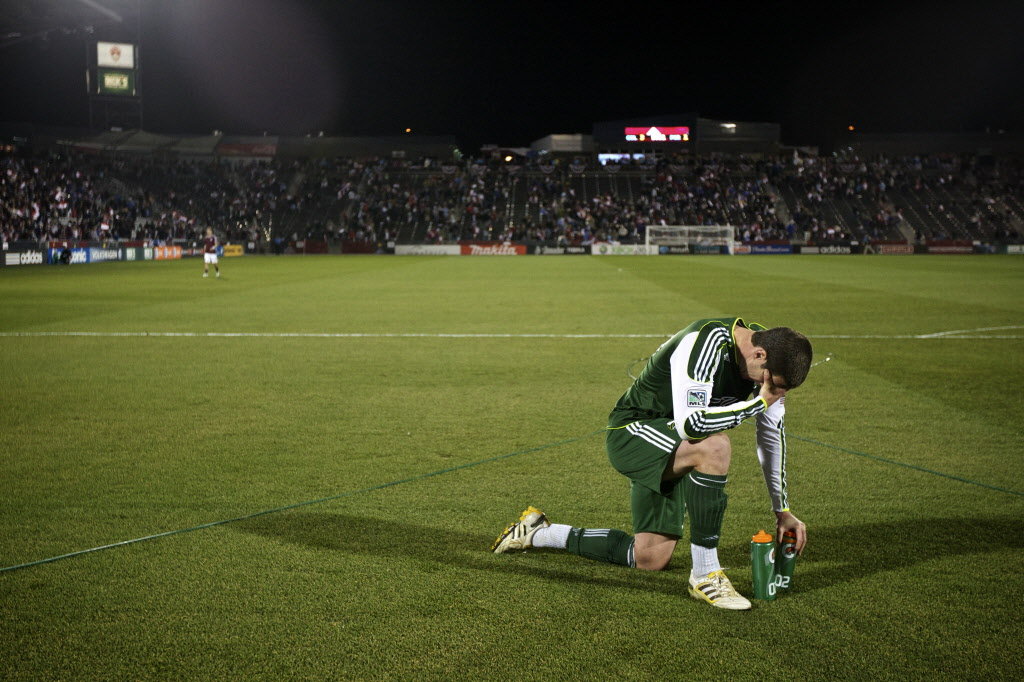 This was just one match, and the first of a long season and, I hope, many seasons of Timbers soccer in the top flight. But it was a spectacularly bad match, and the team has only a week to prepare for Toronto. The failings we watched last night might be the basis for catharsis, or the catalyst for despair. It's now up to the men of the Portland Timbers to choose which direction they will turn.


